Make a Cyclone Shop-Vac Setup for Dust-Free Woodworking
A cyclone on a 5 gal bucket catches the dust before your shop vac does, so the filter stays clean and the suction stays strong. The build, step by step.
Published October 16, 2026 · 6 picks
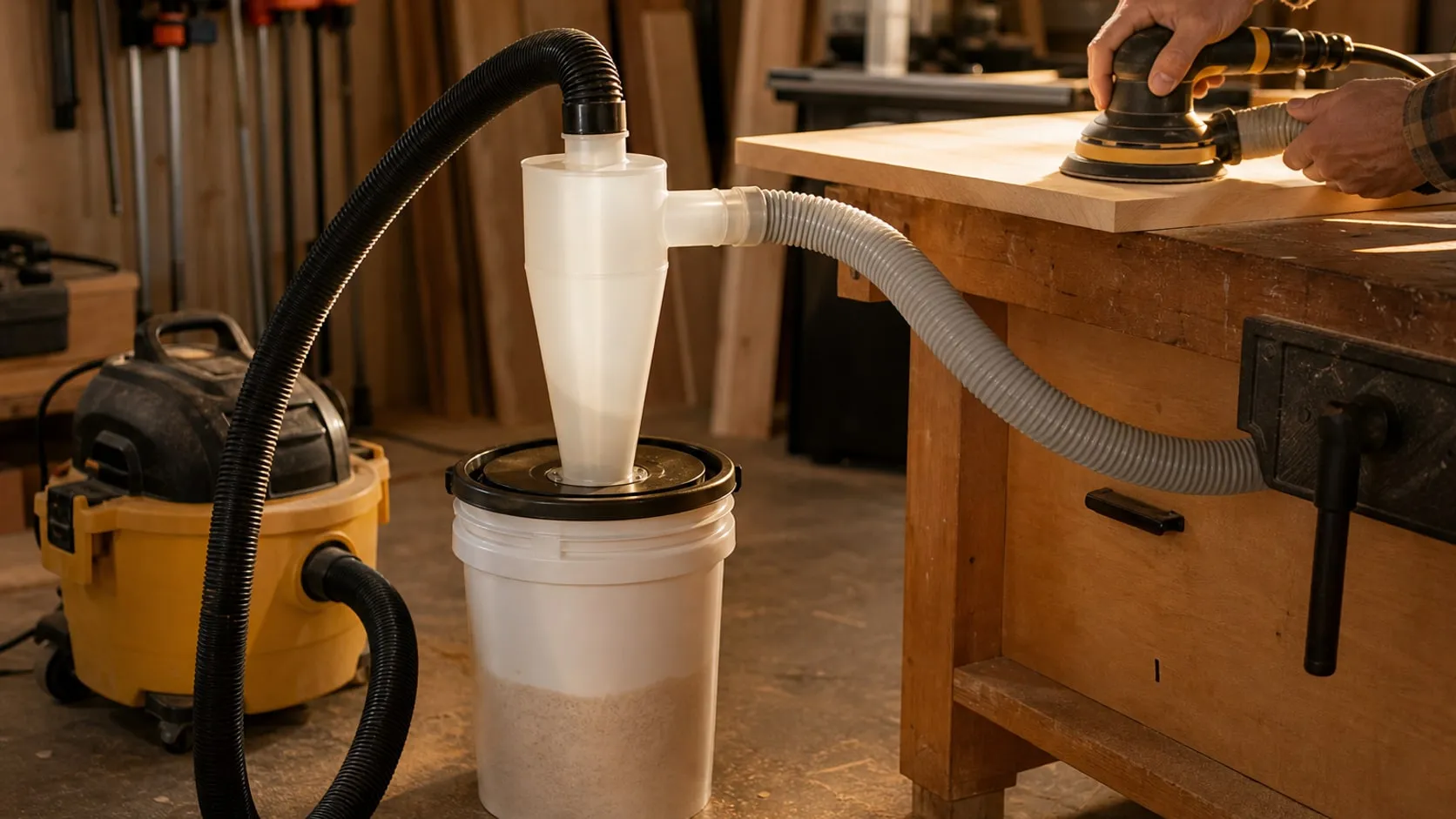
Anyone who sands with a shop vac knows the pattern: ten minutes of great suction, then the filter clogs, the motor whines and the dust starts staying on the wood. The fix that keeps showing up in woodworking videos is a cyclone pre-separator on a 5 gal bucket. It sits between the tool and the vacuum and drops almost all of the dust into the bucket before the air reaches the vac’s filter. It takes an afternoon to build, and it’s mostly drilling a lid. Here’s the whole process, with the parts for each step below.
Step 1: Understand the airflow
The order of the parts matters, so get it straight before you drill anything:
Tool → light tool hose → cyclone side inlet → (dust drops into the bucket) → cyclone top outlet → vac hose → shop vac.
The vacuum still does all the pulling. The cyclone makes the incoming air spin down the cone; heavy chips and most of the dust are thrown against the wall and fall into the bucket, and the cleaned air turns and leaves through the top. That only works if the bucket and lid are airtight. A leak lets air in from below, breaks the swirl, and the dust goes straight to the vac.
Step 2: Mount the cyclone on the lid
The cyclone goes on the spin-off center part of the Gamma Seal lid, not on the ring, so the ring stays on the bucket and the seal never gets disturbed.
- Mark the center of the spin-off lid.
- Trace the hole. Center the cyclone’s gasket on the mark and trace its inner circle, then mark the screw holes through the gasket.
- Cut the hole just inside the line with a hole saw or a drill and jigsaw, and drill the small screw holes. Clamp the lid to a scrap board so it doesn’t spin.
- Assemble. Lid, gasket, cyclone flange, then the screws and hardware from the kit. Tighten them evenly in a star pattern until the gasket is just compressed. Overtightening bends the thin lid and creates the leak you’re trying to avoid.
Smooth the cut edge with sandpaper or a knife. Burrs inside the bucket catch fine dust and make the seal harder to check.
Step 3: Fit the lid ring to the bucket
Press the Gamma Seal ring onto the rim of the bucket. It’s a tight fit on purpose: start it on one side, then work around the rim with a rubber mallet until it seats evenly all the way around. Screw the cyclone lid into the ring.
Use a stiff bucket. Under a shop vac, the bucket holds a slight vacuum, and if the hose gets fully blocked, by a big chip or a hand over the end, that vacuum spikes. A thin bucket can flex and pull away from the ring. Don’t leave the vac running with the hose blocked.
A tall cyclone on a bucket is top-heavy. Stand the bucket inside a short second bucket or a low crate, or strap it to the vac or a small cart, so a tug on the hose doesn’t tip it over.
Step 4: Connect the hoses
- Cyclone outlet to the vac: the vac’s own hose goes from the top port of the cyclone to the vac inlet. The stiff, heavy hose is fine here, because it doesn’t move.
- Tool to the cyclone: the light 10 ft hose goes into the side inlet, with the right click-on adapter at the tool end.
- Dry-fit every joint. The cyclone’s ports are tapered at 2 in, and hose cuffs from different brands fit them differently. If a cuff is loose, wrap the port with aluminum foil tape until it’s snug, or use a rubber reducer. A loose joint here leaks just like a bad lid.
Keep the tool hose as short as the work allows. Every extra foot costs airflow, and a 1-1/4 in hose is meant for hand tools like sanders, track saws and routers, not for a table saw or planer.
Step 5: Set up the vac as the second stage
Leave the vac’s cartridge filter installed and add a disposable filter bag inside the tank. The cyclone catches the bulk; the bag catches the finest dust that rides the air past it, before it reaches the cartridge pleats. With both in place, the cartridge stays clean far longer and emptying the vac means pulling out one sealed bag.
Filter bags are for dry dust only. If you use the vac for water, take the bag out first, and empty and dry the cyclone bucket afterward.
Step 6: Test, use and empty
- Leak test. Turn on the vac and run a hand around the lid ring, the gasket and each hose joint. Any spot where you feel a pull or hear a hiss needs tape or a tighter fit.
- Dust test. Vacuum a handful of sawdust from the floor through the tool hose and look into the vac. Almost nothing should be there; it should all be in the bucket.
- Empty before it’s full. Keep the dust level well below the bottom of the cyclone cone. Once the pile gets close, the swirl starts lifting dust back up and sending it to the vac. Unscrew the lid, set the cyclone aside on the dump bucket, and pour.
Stay safe with fine dust. A cyclone keeps your vac working, but it doesn’t clean the air around the tool. Wear a dust mask or respirator for sanding, especially with MDF and hardwoods. Don’t vacuum hot ashes, sparks or anything burning, and check the vac’s manual before picking up solvents or anything flammable.
What it costs in time: about an hour to cut and assemble the lid, half an hour to sort out hoses and leaks, and after that, a quick twist of the lid whenever the bucket fills. The parts for each step are below.
At a glance
6 picksAs an Amazon Associate I earn from qualifying purchases. If you buy through a link on this page we may earn a small commission, at no extra cost to you. How this works.
Oneida Dust Deputy DIY Cyclone Separator
The cyclone itself, with the gasket and screws to mount it on a lid.
A cyclone pre-separator sits between the tool and the shop vac. Air comes in sideways, spins down the cone, and the heavy dust and chips fall out the bottom into a bucket before the air turns and leaves through the top. Oneida says the Dust Deputy catches up to 99.9% of the debris before it reaches the vacuum, which is the whole point: the vac’s filter stays clean and the suction stays up.
The DIY version is just the cyclone, a gasket and screws. That’s a feature if you want to build the rig yourself, because you choose the bucket, the lid and how it sits next to your vac. Oneida also sells complete kits with a bucket if you’d rather skip the cutting.
Pro tip Use the gasket as the template for the hole in the lid. Trace its inner circle, cut just inside the line, and the cyclone outlet will sit centered with the screw holes landing on solid plastic.
Why we like it
- ✓Comes with the gasket and mounting hardware, so it bolts straight onto a flat lid
- ✓Tapered 2 in ports take a range of common hose cuffs
- ✓Anti-static body, per Oneida, which helps with fine dust clinging inside
- ✓Works with any make of wet/dry vac, wet or dry, and is made in the USA
Keep in mind
- !No bucket, lid or hose in the box; you supply and fit them yourself
- !Hose cuffs don't always seal on the tapered ports first try; expect some tape or a reducer
- !The tall cyclone on a bucket is top-heavy and easy to tip if you yank the hose
- Type
- Cyclone separator, retrofit (DIY)
- Ports
- Tapered 2 in (inlet and outlet)
- Included
- Cyclone, gasket, mounting hardware
- Size
- 15.5 x 9.3 x 7.4 in
- Use
- Wet or dry
- Model
- AXD001004
- Made in
- USA
Gamma2 Gamma Seal Lid
An airtight spin-off lid, so the cyclone seals and the bucket empties fast.
A cyclone only works if the bucket under it is airtight. Any leak at the lid lets air in from below, the swirl inside the cone falls apart, and dust gets carried up into the vacuum instead of dropping out. A snap-on bucket lid can seal, but it’s a pain to pry off every time the bucket fills.
The Gamma Seal solves both. The ring stays on the bucket for good, the center lid screws in against a gasket, and with the cyclone mounted on that center lid, emptying the bucket takes four moves: unscrew, lift, dump, screw back.
Pro tip Drill the cyclone onto the spin-off center lid, not the ring. Then the ring never moves, and the seal you tested once stays good.
Why we like it
- ✓Two-part design, a ring that presses onto the bucket and a lid that screws into it
- ✓Gasket seal keeps air out, which a cyclone needs to work
- ✓Mount the cyclone on the spin-off part and emptying is a twist, not a fight with a snap-on lid
- ✓Food-grade HDPE, made in the USA, fits standard 3.5 to 7 gal buckets
Keep in mind
- !Pressing the ring onto the bucket rim takes force; a rubber mallet helps
- !The lid is flat but not thick, so tighten the cyclone screws gently
- !Sold for pet food and storage; using it for a cyclone means drilling it yourself
- Parts
- Adapter ring + spin-on lid
- Fits
- Standard 3.5, 5, 6 and 7 gal buckets
- Diameter
- About 12 in
- Material
- HDPE
- Closure
- Spin on / off
- Model
- 4123
United Solutions 5 Gallon Bucket, 3-Pack
Stiff 5 gal buckets, one for the cyclone and a spare to dump into.
Any sturdy 5 gal bucket can carry a cyclone, but the bucket does more work than it looks. Under a shop vac it’s holding a slight vacuum, and if the hose gets fully blocked by a chip or your hand, that vacuum jumps. A stiff bucket with reinforced rings shrugs that off; a thin, floppy one can flex and pull the seal off the lid.
These come three to a pack, which suits a cyclone rig well: one bucket wears the cyclone, one sits next to it as the dump bucket so you’re never carrying the cyclone outside, and one is a spare for the next thing in the shop.
Pro tip Set the cyclone bucket inside a short second bucket or a low crate. The wider base makes the tall rig much harder to tip over when you pull the hose across the bench.
Why we like it
- ✓Standard 12.5 in round 5 gal size, which fits the Gamma Seal ring
- ✓Reinforced rings around the body add stiffness, useful under vacuum
- ✓Metal handle with a plastic grip for carrying a full bucket of dust out
- ✓Three in a pack, so a spare bucket is ready as the dump bucket
Keep in mind
- !Lids not included
- !Tapered sides mean a full bucket nests a little unsteadily under a tall cyclone
- !Thin-walled compared with a commercial pail; don't leave the hose fully blocked with the vac running
- Capacity
- 5 gal (19 L)
- Size
- 12.5 in diameter x 14.25 in tall
- Material
- Plastic, steel handle
- Count
- 3 buckets, no lids
- Model
- PN0166
DEWALT DXV06P 6 Gallon Wet/Dry Vac
A compact 6 gal, 4 HP vac with the hose that links it to the cyclone.
The vacuum is the engine of a cyclone rig. The cyclone doesn’t make suction; it borrows the vac’s airflow and uses it to throw dust out of the air stream. A mid-sized vac with a 4 HP motor is a common match for a single 5 gal cyclone, and a small tank is fine, because with the cyclone doing its job, very little ends up in the vac.
The DXV06P is compact enough to sit next to the bucket on a small cart, and it comes with the hose that will connect the cyclone’s top outlet to the vac inlet. It also has a blower port, handy for clearing chips from a bench, though not with the cyclone attached.
Pro tip Keep the cartridge filter installed even with the cyclone in front. DEWALT warns that the vac can shut down if it runs without a filter, and the filter is the last line between fine dust and the air you breathe.
Why we like it
- ✓4 peak HP motor on 120 V, a common size for pairing with a cyclone
- ✓Comes with a 1-7/8 in x 7 ft hose, wands, nozzles, cartridge filter and a dust bag
- ✓Built-in blower port and a 10 ft cord with a cord wrap
- ✓Small 6 gal tank that sits next to a 5 gal bucket without taking over the floor
Keep in mind
- !77 dB, per the listing, which is loud; wear hearing protection for long runs
- !Single speed, no power-tool auto-start outlet
- !The stock 7 ft hose is stiff; you'll want a lighter hose on the tool side
- Tank
- 6 gal (23 L), poly
- Motor
- 4 peak HP
- Power
- 120 V, 8 A, corded
- Cord
- 10 ft
- Hose
- 1-7/8 in x 7 ft
- Filter
- Cartridge (dust bag included)
- Noise
- 77 dB (per listing)
- Weight
- 14.8 lb
- Model
- DXV06P
Cen-Tec Quick Click 10 ft Hose with Power Tool Adapters (94698)
A light hose with click-on adapters for most sanders and saws.
The tool side of a cyclone rig is where most of the frustration lives. Every sander and saw has a different dust port, and the shop vac’s own hose is thick, stiff and heavy enough to pull a random-orbit sander off the work. A thinner, lighter hose with a set of click-on adapters fixes both.
Cen-Tec’s kit pairs a 10 ft hose with adapters for the common port sizes, and each one clicks into a collar on the hose end, so moving from the sander to the jigsaw takes a few seconds. The swivel ends keep the hose from twisting, and the air-relief collar lets you bleed off suction when it grabs the work too hard.
Pro tip On a random-orbit sander, open the air-relief collar a little. Full suction can pull the pad flat against the work and leave swirl marks; a bit less suction still clears the dust.
Why we like it
- ✓1-1/4 in x 10 ft hose is far lighter and more flexible than a stock shop-vac hose
- ✓Quick-click adapters for 3/4, 1, 1-1/4 and 1-1/2 in tool ports, inside and outside
- ✓Swivel ends and an air-relief collar to turn suction down on small tools
- ✓Fits Bosch, DEWALT, Makita, Ryobi, Festool, Milwaukee and other major brands, per Cen-Tec
Keep in mind
- !The tank end is sized for 2-1/2 in vac inlets, so on a 2 in cyclone port it may need tape or a reducer
- !A 1-1/4 in hose limits airflow; it's for hand tools, not for a table saw or planer
- !Small fittings to keep track of when they're not on the hose
- Hose
- 1-1/4 in diameter x 10 ft
- Tool adapters
- 3/4, 1, 1-1/4, 1-1/2 in
- Tank end
- Standard 2-1/2 in shop vac connection
- Extras
- Swivel bayonet fitting, air relief, quick-click collar
- Model
- 94698
DEWALT DXVA19-4101 Disposable Filter Bags, 6-Pack
A bag in the vac for the fine dust that gets past the cyclone.
A cyclone catches the bulk of the dust, but not all of it. The finest particles, the ones from sanding, are light enough to ride the air up the cyclone’s outlet and into the vacuum. Without a bag, they go straight into the cartridge filter’s pleats, and a clogged filter is exactly the suction loss the cyclone was meant to prevent.
A disposable bag inside the tank catches that fine dust first. With a cyclone in front, the bag fills slowly, the cartridge filter stays clean much longer, and emptying the vac means pulling out one sealed bag instead of tapping a filter outside in a cloud.
Pro tip Write the date on each new bag with a marker. With a cyclone in front a bag can last months, and it’s the easiest way to know when it’s time to check it.
Why we like it
- ✓Fits the DXV06P and DEWALT's 9 and 10 gal vacs, per the listing
- ✓Catches the fine dust that gets past the cyclone before it reaches the cartridge filter
- ✓Rubber seal and cardboard collar slide onto the vac inlet in seconds
- ✓Six bags, and with a cyclone in front each one lasts a long time
Keep in mind
- !Dry pickup only; take the bag out before vacuuming water
- !Only for DEWALT vacs on the compatibility list
- !Paper bags tear if you overfill them or pull them off roughly
- Fits
- DEWALT DXV06P, DXV09P, DXV09PA, DXV10P, DXV10PL, DXV10S, DXV10SA, DXV10SB
- Material
- Paper, disposable
- Inlet
- 2.5 in collar with rubber seal
- Size flat
- About 31.5 x 15.8 in
- Count
- 6 bags
- Use
- Dry only
- Model
- DXVA19-4101