Build a Compact Dust-Extraction Kit for Handheld Tools
A small HEPA vac, a low-profile cyclone and a light hose that follow your sander around the garage. The kit, step by step, for winter shop work.
Published October 29, 2026 · 7 picks
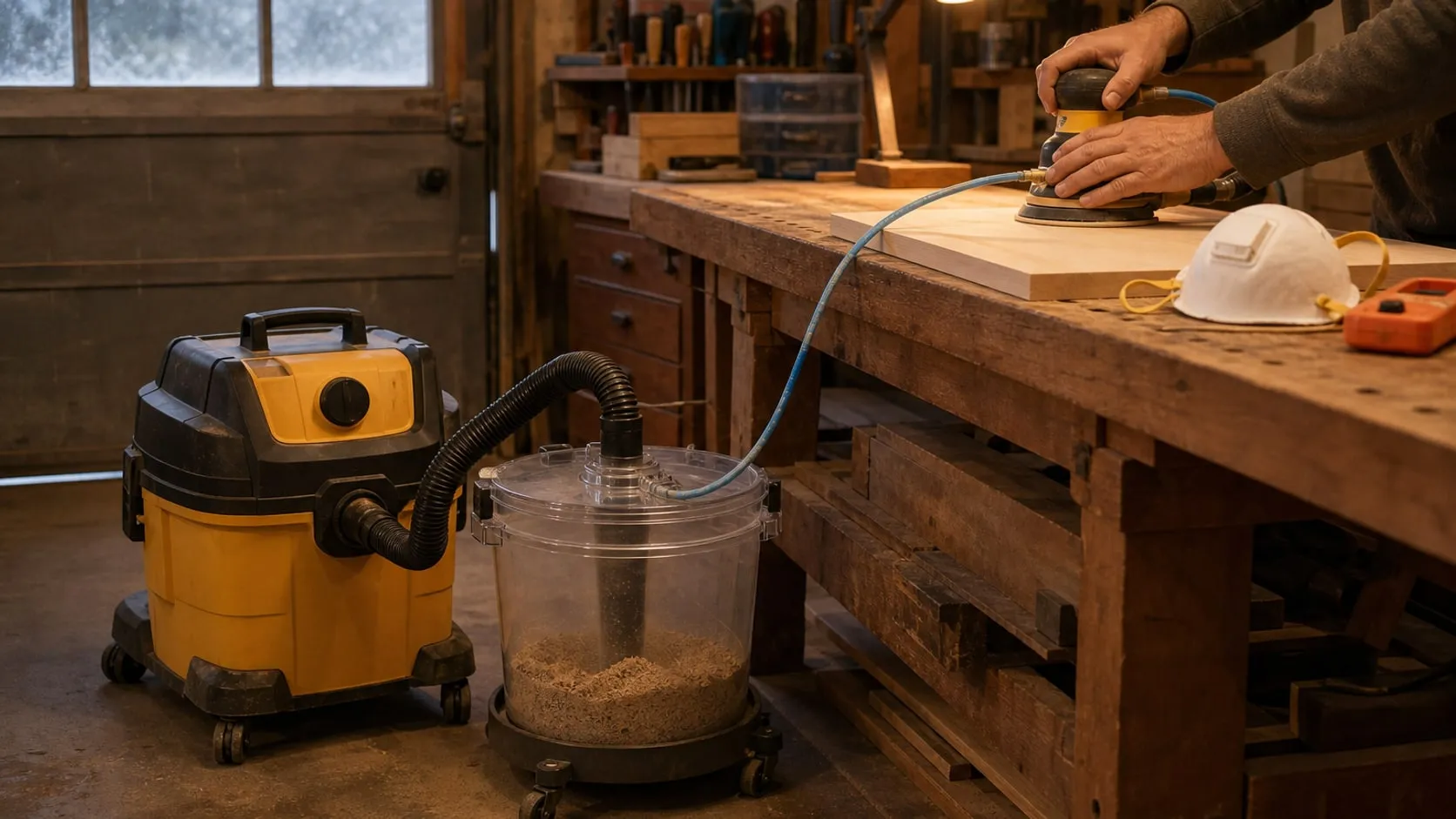
When it gets cold, the sanding and routing move inside: into the garage with the door closed, or a corner of the basement. That’s exactly when dust becomes a problem, because there’s no breeze to carry it away and it settles on everything, including the car. A full dust collector is overkill for handheld tools. What they need is a small, portable kit: a compact vac with a HEPA filter, a cyclone to keep that filter clean, and a light hose that connects to whatever tool is in your hand. Here’s how to put one together, with the parts for each step below.
Step 1: Pick a small vac, not a big one
Handheld tools have small dust ports, and they need steady suction through a thin hose, not a huge tank. A 4–6 gal vac does that job and stays light enough to carry with one hand to the bench, the driveway or a job across town.
Look for three things:
- A filter you can upgrade to HEPA. This matters more than horsepower for fine sanding dust.
- A shape that packs up. A handle on top and somewhere to wrap the cord make it a kit, not a pile.
- An inlet that matches standard fittings, or a known reducer for it. Check the size before you order hoses.
Step 2: Fit a HEPA filter
The standard cartridge in most shop vacs stops chips and coarse dust, but the finest particles from sanding can go straight through and out of the exhaust, back into the air you’re breathing. A HEPA-rated cartridge catches them.
- Unplug the vac and open the lid.
- Remove the stock cartridge and knock any dust off the cage it sits on.
- Fit the HEPA cartridge and tighten the cap until it’s seated all the way round. A cartridge that sits crooked lets dust bypass it entirely.
Keep the stock filter for wet pickup. A HEPA cartridge shouldn’t be used to suck up water, and it needs to dry fully after washing.
Step 3: Add a cyclone in front of the vac
A HEPA filter clogs quickly on its own: fine dust packs into the pleats, suction drops, and you’re cleaning the filter every half hour. A cyclone separator between the tool and the vac drops most of the dust into a bucket first, so the filter only sees what’s left.
The airflow order is: tool → light hose → cyclone inlet (side) → dust drops into bucket → cyclone outlet (top) → short hose → vac.
For a portable kit, a low-profile lid cyclone is easier to live with than a tall cone: it doesn’t tip over, it fits under a bench, and with casters the bucket rolls along beside the vac. Latch the lid on evenly, and check that the gasket sits flat all the way round. A leak at the lid lets air in from below and the dust goes straight to the vac.
Step 4: Connect the hoses and adapters
- Cyclone to vac: use the short hose that comes with the cyclone kit. The cyclone’s ports take standard 2.5 in vac hose fittings; if your vac’s inlet is smaller, dry-fit first and use a reducer or a wrap of foil tape for a snug fit.
- Tool to cyclone: a 1-1/4 in hose at the tool end. It’s light enough not to pull a sander off the work, and an antistatic one stops fine dust from clinging inside.
- Odd tool ports: a stepped rubber adapter, cut at the step that matches the port, covers older or oddly shaped outlets the click-on adapters don’t.
Every joint is a possible leak. With the vac running, run a hand around each one; if you feel a pull or hear a hiss, tighten or tape it.
About static: fine dust moving fast through plastic builds a static charge, which shows up as dust clinging to the hose and the occasional zap from the tool. An antistatic hose can only drain that charge if the vac end is grounded, and a plastic vac and bucket aren’t. Expect fewer shocks, not none, and never use a shop vac to pick up anything flammable.
Step 5: Make the vac start with the tool
The most common reason dust collection doesn’t get used is that it’s one more switch. An automatic vacuum switch fixes that: plug the tool and the vac into it, set it to Auto, and leave the vac’s own switch on. The vac starts when the tool starts and keeps running for a few seconds after it stops, which clears the hose.
Check the current before you rely on it. The tool and the vac together have to stay within the switch’s rating and your circuit’s (15 A on most household outlets). A small vac and a sander are usually fine; a big saw and a vac on one circuit may trip the breaker.
Step 6: Use it, empty it, and still wear a mask
- Test it. Sand a scrap for a minute, then look into the vac. Almost all the dust should be in the bucket.
- Empty early. Once the bucket is about two-thirds full, separation gets worse and dust starts reaching the vac. Empty it outdoors or into a bag, and wear the mask while you do.
- Tap out the filter every few sessions, outdoors, before it gets caked.
The kit doesn’t clean the air. It catches dust at the tool, but some still escapes, especially from routers and around the edges of a sander pad. In a closed garage, wear an N95 or better for sanding, keep a window or door cracked when the weather allows, and avoid sweeping, which throws the finest dust back into the air. Vacuum the floor instead.
What it costs in time: about half an hour to unbox the cyclone, fit the HEPA filter and sort out the hose joints. After that, plugging in two cords and emptying a bucket when the line says so. The parts for each step are below.
At a glance
7 picksAs an Amazon Associate I earn from qualifying purchases. If you buy through a link on this page we may earn a small commission, at no extra cost to you. How this works.
DEWALT DXV04T 4 Gallon Portable Wet/Dry Vac
A 4 gal toolbox-shaped vac that's easy to carry to the work.
For hand-tool dust, a big 16 gal vac on wheels is mostly wasted space. A sander or a trim router only needs steady suction at the end of a light hose, and a 4 gal vac does that while staying small enough to set on a bench or carry to the driveway. The DXV04T is shaped like a toolbox, with the handle on top and the cord wrapped on the side.
Behind a cyclone, the small tank stops being a problem: the bucket takes the bulk of the dust, and the vac mostly moves air. Fit it with the HEPA cartridge and it becomes the last line before the dust gets back into the room.
Pro tip Set the vac below the work, on the floor or a low shelf, rather than on the bench next to you. The motor exhaust blows away from the fresh surface, and the hose drapes down instead of dragging across the workpiece.
Why we like it
- ✓Compact toolbox shape, 12.5 x 15 x 19 in and about 13 lb, easy to carry by the top handle
- ✓4 gal tank is plenty behind a cyclone, which catches most of the dust first
- ✓Takes DEWALT's DXVC4003 HEPA cartridge, so fine dust can be filtered at the vac
- ✓Cord wraps on the body, so the whole unit packs up as one piece
Keep in mind
- !Single speed and no tool-triggered outlet; it needs an auto switch to start with the tool
- !Around 80 dB, per the listing, so hearing protection makes sense for long sessions
- !The listing gives almost no detail; check the hose inlet size against your fittings before you buy them
- Capacity
- 4 gal
- Motor
- 5.0 peak HP
- Hose length
- 7 ft
- Filter
- Cartridge (HEPA DXVC4003 compatible)
- Size
- 12.5 x 15 x 19 in
- Weight
- 13.2 lb
- Voltage
- 120 V
- Model
- DXV04T
DEWALT DXVC4003 HEPA Cartridge Filter
Swaps the stock cartridge for one that holds on to fine sanding dust.
A stock shop-vac cartridge stops chips and coarse dust, but the finest sanding dust, the kind that hangs in the air and settles on everything overnight, can pass through it and out the exhaust. A HEPA cartridge is the upgrade that deals with that, and it matters more in a closed garage in winter than on an open driveway in summer.
The DXVC4003 drops into the DXV04T in place of the standard filter. In a kit with a cyclone, it sees only the fraction of dust that gets past the bucket, which keeps the pleats open far longer.
Pro tip Tap the cartridge out into a bag outdoors before you wash it. Rinsing a filter caked with dust just makes mud in the pleats, and it takes much longer to dry.
Why we like it
- ✓HEPA-rated pleated cartridge; DEWALT says it captures 99.97% of particles down to 0.3 micron
- ✓Washable and reusable, so one cartridge lasts many cleanings
- ✓Fits the DXV04T and several other DEWALT 4–8 gal vacs, including the DXV05P, DXV06G and DXV08S
- ✓Twist-on cap, no tools to swap it
Keep in mind
- !Fits DEWALT vacs only, and not every model; check your vac's number first
- !Has to dry completely after washing before it goes back in, so a spare is handy
- !Fine dust still loads the pleats quickly without a cyclone in front of it
- Type
- HEPA cartridge filter, washable
- Fits
- DXV04T, DXV05P, DXV05S, DXV06G, DXV06PL, DXV08S (and variants)
- Size
- 5.8 x 5.8 x 6.2 in
- Model
- DXVC4003
Oneida Dust Deputy Low-Pro Deluxe Separator Kit
A 4 in tall cyclone lid on a clear bucket with casters, so the vac stays clean.
A tall cyclone on a bucket works, but it’s top-heavy and hard to move around a small shop. The Low-Pro takes the same idea and flattens it into a lid: air comes in through the side port, spins inside the lid, and the dust drops into the bucket before the air leaves for the vac. Oneida says it catches up to 99.9% of the debris.
For a portable kit, the useful part is everything around the lid. The bucket latches on, sits on casters, and the base has slots for hose fittings, so the separator, hose and adapters travel as one unit and the clear plastic tells you when it’s time to empty.
Pro tip Put a strip of tape on the bucket about two-thirds of the way up and empty it when the dust reaches the line. A bucket filled to the lid starts sending dust back into the vac.
Why we like it
- ✓Only 4 in tall, so the rig stays low and stable instead of top-heavy
- ✓Complete kit with the clear 5 gal bucket, latching lid, caster base, 3 ft hose and elbows
- ✓Clear bucket shows the dust level at a glance
- ✓Caster mounts have slots for storing hose fittings, and it works wet or dry, per Oneida
Keep in mind
- !Ports are sized for standard 2.5 in vac hose fittings (2.25 in I.D.); a smaller vac may need a reducer
- !A lid-style separator gives up some separation compared with a tall cone, so a good vac filter still matters
- !The clear bucket is for viewing, not for heavy knocks; don't stand on it or use it as a step
- Type
- Low-profile lid cyclone separator kit
- Height
- 4 in (lid)
- Bucket
- Clear, 5 gal
- Ports
- 2.25 in I.D., for 2.5 in vac hose fittings
- Included
- Lid, latches, bucket, caster base, 2 in x 36 in hose, 2 elbows, gaskets, hardware
- Model
- AXD259922
- Made in
- USA
Cen-Tec 94434 16 ft Antistatic Hose with Tool Adapters
A light antistatic hose with click-on adapters for the common tool ports.
The hose is the part of a dust kit you actually hold, so it decides whether you keep the kit on the tool. A thick stock vac hose pulls a palm sander sideways and drags across the work. A 1-1/4 in hose at the tool is light enough to forget about, and this one widens toward the vac so the air slows less on the long run back.
Plastic hoses also build static as fine dust rushes through them: dust clings to the walls and you get the odd zap off the tool. Cen-Tec’s hose and fittings are made to dissipate that charge, which works best when the vac end is grounded.
Pro tip Coil the hose in big loops, never tight ones, and hang it over a hook rather than a nail. Kinks in a thin hose become permanent flat spots that catch chips.
Why we like it
- ✓16 ft reach, so the vac and bucket can stay out of the way
- ✓Tapers from 1-1/4 in at the tool to 1-1/2 in at the vac end, which Cen-Tec says improves airflow and cuts clogs
- ✓Static-dissipative hose and fittings, which helps fine dust stop clinging inside
- ✓Two click-on bayonet adapters, for 1 in and 1-1/2 in tool ports, with 360° swivel and an air-relief collar
Keep in mind
- !The antistatic design only drains static when the vac end is grounded; on a plastic vac and bucket it can't fully stop shocks
- !Two adapters cover the common ports, not every odd one; some tools still need a rubber step adapter
- !A 16 ft hose costs some suction compared with a shorter one
- Length
- 16 ft
- Tool end
- 1-1/4 in hose, adapters for 1 in and 1-1/2 in ports
- Vac end
- 2-1/4 in tank cuff
- Material
- Antistatic TPE
- Weight
- 3.1 lb
- Model
- 94434
Shop-Vac 9068733 Universal Tool Adapter
A cut-to-fit rubber cone for the tool nothing else fits.
Every kit eventually meets a tool that doesn’t fit. An old palm sander with an oval port, a jigsaw with a stubby outlet, a hose from one brand on a fitting from another. Click-on adapter sets cover the common sizes; a stepped rubber cone covers the rest.
Shop-Vac’s universal adapter is a soft rubber cone with several steps. You find the step that matches the port, cut the cone just below it, and the rest of the adapter fits into your hose. The square flange with screw holes also lets you mount it on a dust box or a homemade shroud.
Pro tip Cut one step smaller than you think. A snug, slightly stretched fit seals better and holds on a vibrating tool; a loose one leaks and falls off.
Why we like it
- ✓Stepped soft rubber cone, cut at the step that matches the port you have
- ✓Flange with screw holes, so it can also be mounted on a dust box or shroud
- ✓Flexible enough to seal on slightly oval or worn ports
- ✓Small and light, an easy spare to keep in the kit
Keep in mind
- !Once you cut it, it only fits that size and smaller ones; one adapter usually covers one tool
- !It's a friction fit, so on a vibrating sander it may need a wrap of tape to stay put
- !The listing doesn't give the step diameters; measure your port and compare by eye
- Type
- Universal stepped tool adapter, cut-to-fit
- Material
- Soft rubber
- Weight
- 4 oz
- Model
- 9068733
Ortis Automatic Vacuum Switch
Starts the vac with the tool and stops it a few seconds after.
Dust collection fails in small ways. You start the sander, forget the vac, and the first minute of dust is already on the bench. Or you switch the tool off and walk away while the hose is still full of dust. An automatic switch takes both out of the loop: plug the tool and the vac into it, and the vac follows the tool.
The Ortis switch senses when the tool draws power, starts the vac a second later, and keeps it running for a few seconds after the tool stops, so the hose clears before it goes quiet. The threshold setting matters for small tools: a low-power palm sander may need the 30 W setting to trigger reliably.
Pro tip Add up the amps on the tool and vac labels before you plug both in. If they’re over 15 A together, run them on the switch with a smaller vac, or put them on separate circuits and switch the vac by hand.
Why we like it
- ✓Auto, Off and On modes, with LED indicators for each setting
- ✓Adjustable trigger threshold (30 W or 60 W) for small and large tools
- ✓Shutoff delay of 3, 7 or 10 seconds clears the hose after the tool stops
- ✓Two tool outlets, plus a 1 second start delay so tool and vac don't start at the same instant
Keep in mind
- !Tool and vac together must stay within 15 A on one circuit; a big vac plus a big saw can trip the breaker
- !The vac has to be left switched on at its own switch, which is easy to forget when you unplug it
- !Another box and cord to manage in a portable kit
- Rating
- 120 V, 15 A, 1875 W max
- Modes
- Auto / Off / On
- Trigger threshold
- 30 W or 60 W
- Shutoff delay
- 3, 7 or 10 s
- Outlets
- 1 vacuum, 2 tool
- Model
- DJS-JJ7340
3M 8511 N95 Cool Flow Valved Respirator (10-Pack)
A valved N95 for the dust that still gets past the hose.
A dust extractor on a sander catches most of the dust at the pad, but not all of it. Some escapes around the edges, some comes off the router bit in a spray, and some gets kicked back up when you sweep. In a closed garage that fine dust stays in the air for a long time, which is why a mask belongs in the kit next to the vac.
The 8511 is a disposable N95 with an exhalation valve. The valve lets warm breath out, so the mask stays cooler and your safety glasses fog less on a long sanding job.
Pro tip Do a quick seal check every time you put it on: cover the mask with both hands and breathe in sharply. It should pull in slightly against your face; if you feel air at the nose or edges, adjust the clip and straps.
Why we like it
- ✓NIOSH-approved N95 for non-oil-based particles like wood and drywall dust
- ✓Cool Flow exhalation valve; 3M says breathing is up to 50% easier than with its non-valved 8200
- ✓Adjustable M-noseclip and braided headbands for a better seal
- ✓Ten disposable masks, enough for a lot of sanding sessions
Keep in mind
- !Disposable; it has to be replaced when it's dirty, damaged or harder to breathe through
- !No protection against vapors from finishes or solvents; that needs a cartridge respirator
- !Beards and stubble break the seal, as with any tight-fitting mask
- Rating
- NIOSH N95
- Valve
- 3M Cool Flow exhalation valve
- Count
- 10 respirators
- Style
- Disposable, cup shape
- Model
- 8511