How to Build a Mobile Charging Station for Cordless Tools
A rolling cart that charges your tool batteries, phone and laptop anywhere — on the job, in the yard or at a craft-market booth. Six steps and the gear.
Published October 4, 2026 · 7 picks
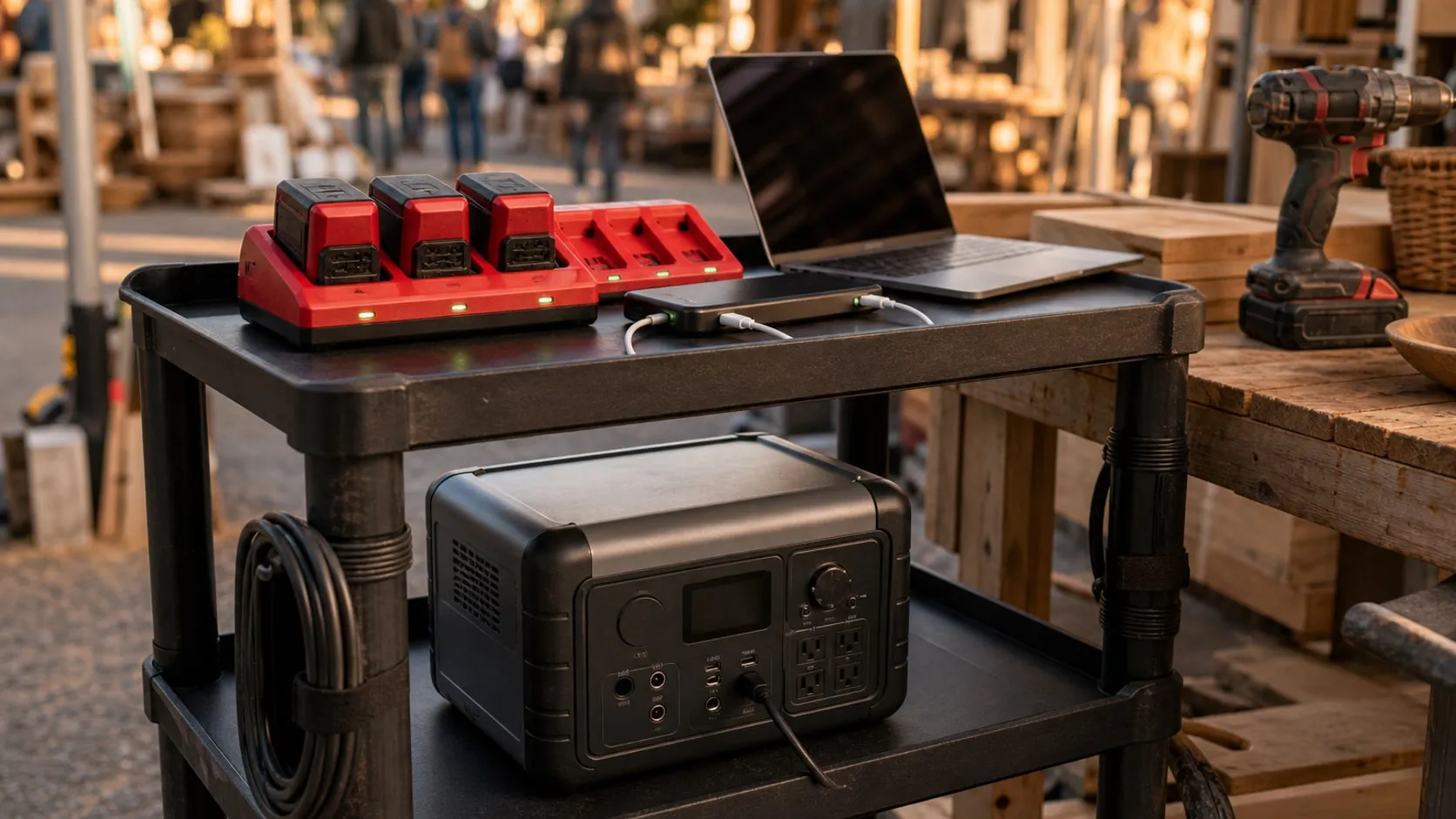
Cordless tools solved the cord problem and created a battery problem: by mid-afternoon half the packs are empty and the charger is back in the shop. Portable power stations and battery adapters (EGO’s Nexus, Milwaukee’s Carry-On and TOP-OFF, and their equivalents from other brands) have made it practical to bring the charging with you. Put them on a cart and you have a rolling charging station for a job site, a yard, or a booth at a craft market. Here’s how to put one together, step by step, with the gear for each step below.
Step 1: Pick the power source
Everything on the cart runs from one big battery, so size it first. Add up what you’ll charge in a day:
- Tool batteries: volts × amp-hours = watt-hours. An 18/20 V 5 Ah pack is about 90–100 Wh.
- Small devices: a phone is around 15 Wh, a laptop 50–100 Wh.
- Losses: chargers and inverters waste part of the energy, so add 20–30%.
Six 5 Ah packs plus a phone and a laptop come to roughly 700–800 Wh, which is why a station of about 1 kWh is a sensible size for a cart. Also check continuous output: it has to be higher than everything you’ll plug in at once. If you already own a big battery platform, a battery-powered station that runs on your tool packs (like EGO’s Nexus) is the alternative.
Step 2: Add a battery adapter for small loads
A battery adapter clicks onto a tool battery and gives you an outlet and USB ports. On the cart it’s the backup for small things, a phone, a card reader or a work light, and it lets a spare pack do something useful instead of sitting in a bag. Pick one made for your brand’s batteries and keep the load small: these adapters are rated in the low hundreds of watts, not enough to run a charger or a power tool.
Step 3: Choose a multi-bay charger
One charger per battery means a cart full of power bricks and not enough outlets. A multi-bay charger puts four to six packs on a single plug. Two things to know:
- Sequential vs. simultaneous. Many multi-bay stations charge one pack after another; dual chargers often charge both at once. Sequential is fine overnight; simultaneous is better when you need packs back during the day.
- Input watts. Look at the label on the charger, and make sure it fits within the power station’s continuous output with room to spare.
Stick with the charger made by your tool brand, or one the brand lists as compatible with your batteries.
Step 4: Add USB-C and outlets for everything else
Phones, laptops, LED lights and the growing number of USB-C rechargeable tools don’t need a tool charger. A compact USB-C charging hub plugged into the power station handles all of them, and keeps the station’s own outlets free for the tool chargers. Look for USB-C ports that deliver 60–100 W or more, enough for a laptop, not just a phone.
Step 5: Set up the cart
A cart with deep trays and big casters works better than a box you have to carry. Lay it out by weight:
- Bottom shelf: the power station, for a low center of gravity.
- Top shelf: chargers and the USB hub, where you can see the indicator lights.
- Leave room around vents. Chargers and inverters get warm under load; don’t pile bags or jackets on them.
- Keep it dry. Power stations and chargers are not weatherproof. Outdoors, park the cart under a canopy or table, never in the rain or standing water.
Step 6: Tame the cables
Every charger and hub brings a cord. Strap each one to the cart near its plug, coil the extra length and bundle it, so nothing hangs off the side where it can snag on a doorframe or trip a customer at a market booth. Reusable straps beat zip ties here, because you’ll swap chargers around.
Safety basics: use the chargers made for your batteries, don’t charge a pack that’s damaged, swollen or has been dropped hard, let hot packs cool before charging, and don’t leave a full cart charging unattended overnight in a vehicle. The gear for each step is below.
At a glance
7 picksAs an Amazon Associate I earn from qualifying purchases. If you buy through a link on this page we may earn a small commission, at no extra cost to you. How this works.
Anker SOLIX C1000 Gen 2 Portable Power Station (1,024 Wh)
About 1 kWh of storage with ordinary outlets — the heart of the cart.
A portable power station is a big battery with an inverter and ordinary outlets on the front. For a charging cart it does the job of a wall outlet: you plug your normal tool chargers into it, along with a power strip and whatever else the booth or job needs, and roll the whole thing to where the work is.
The C1000 Gen 2 sits in the middle of the range: about 1 kWh of storage, enough output to run a multi-bay charger with headroom to spare, and a LiFePO4 battery, a chemistry generally chosen for long cycle life. At around 25 lb it’s portable, but it’s the heaviest thing on the cart, so it goes on the bottom shelf.
Pro tip Do the math before the market day: a tool battery holds a known number of watt-hours (an 18 V 5 Ah pack is about 90 Wh). Charging losses eat part of that, so plan on roughly 70–80% of the station’s capacity actually ending up in your packs.
Why we like it
- ✓1,024 Wh LiFePO4 battery, rated 2,000 W continuous (3,000 W peak)
- ✓10 output ports, including AC outlets and USB-C
- ✓Anker says it recharges from a wall outlet in about 49 minutes (fast mode enabled in the app)
- ✓Solar input up to 600 W for recharging off-grid
- ✓Anker rates the battery at 80% capacity after 4,000 cycles; 5-year warranty
Keep in mind
- !About 25 lb (11.3 kg) — it belongs on a cart, not carried across a parking lot all day
- !The fastest recharge mode has to be turned on in the Anker app
- Capacity
- 1,024 Wh (LiFePO4)
- AC output
- 2,000 W continuous, 3,000 W peak
- Ports
- 10
- Solar input
- Up to 600 W (60 V max)
- Size
- 15.1 × 8.2 × 9.6 in
- Weight
- 11.3 kg (about 25 lb)
- Model
- A1763
Milwaukee M18 TOP-OFF 175W Power Supply (2846-20)
Turns a spare M18 pack into a small outlet with USB for light loads.
A battery adapter is the small version of a power station: it uses a tool battery you already own as the energy source. On a charging cart that’s handy for the low-power stuff, like a phone, a card reader at a market table or a laptop, without running another cord back to the main power station.
The TOP-OFF only fits Milwaukee M18 packs. DeWalt, Makita, EGO and other brands sell their own adapters, and there are third-party ones for most platforms; whichever you pick, check the continuous wattage, not just the peak figure.
Pro tip A 175 W adapter on a 5 Ah M18 pack (about 90 Wh) runs a 10 W phone charger for hours, but a 150 W laptop for well under an hour. Divide the battery’s watt-hours by the load to get a rough runtime.
Why we like it
- ✓175 W continuous output from any M18 battery
- ✓AC outlet plus USB charging on one compact unit
- ✓Pure sine wave output, according to the listing
- ✓Rafter hook to hang it on a cart, shelf or framing
- ✓About 1.1 lb without a battery
Keep in mind
- !175 W is for small loads — not for tools, heaters or a battery charger
- !Tool only; the battery is not included
- Input
- Milwaukee M18 battery (18 V)
- Output
- 175 W continuous
- Outlets
- AC + USB
- Waveform
- Pure sine wave
- Weight
- 1.1 lb (without battery)
- Model
- 2846-20
Milwaukee M12 & M18 Rapid Charge Station (48-59-1807)
Six M12 and M18 batteries on one charger and one plug.
One charger per battery turns a cart into a tangle of power bricks. A multi-bay station puts all the packs in one place on one cord, which is exactly what you want when the power comes from a station with a limited number of outlets.
This one takes both Milwaukee platforms, M12 and M18, so the small-tool and full-size batteries charge on the same unit. The trade-off is time: a multi-bay station works through the packs rather than blasting all six at once, so it’s best loaded at the end of the day.
Pro tip Look at the input wattage on the charger’s label before plugging it into a power station, and leave some headroom. And let hot batteries cool down before charging; most chargers wait until a pack is cool enough anyway.
Why we like it
- ✓Six bays for M12 and M18 batteries on one plug
- ✓Carry handle on top
- ✓Indicator light above each bay
- ✓ETL listed
Keep in mind
- !Multi-bay stations like this charge in sequence, so a full load of six takes hours, not minutes
- !At 8.2 lb and almost 14 in wide, it takes up a whole corner of a cart shelf
- Bays
- 6 (M12 and M18)
- Input
- 120 V AC
- Size
- 13.8 × 8.45 × 9.5 in
- Weight
- 8.2 lb
- Listing
- ETL
- Model
- 48-59-1807
DEWALT 12V/20V MAX Dual Charging Station with USB (DCB102)
Two 12V/20V MAX packs charging at the same time, plus USB.
If your tools are yellow, this is the DeWalt counterpart to a multi-bay station: two bays that charge at the same time instead of one after the other, in a flat case that sits well on a shelf. For one person with a handful of batteries, two bays running in parallel is often enough.
The LED panel is the useful part on a cart: it tells you whether a pack is charging, done, waiting because it’s too hot or too cold, or bad, so you don’t find out the next morning.
Pro tip Hold it down on the cart with a couple of strips of heavy-duty hook-and-loop tape, so it doesn’t slide off when the cart rolls over a curb, and you can still lift it off to take it inside.
Why we like it
- ✓Charges two 12V MAX or 20V MAX batteries simultaneously
- ✓Two USB-A ports for phones and small devices (1.5 A max)
- ✓LED diagnostics show charging, charged, hot/cold delay and bad pack
- ✓Flat, low design that fits on a cart shelf
- ✓3-year limited warranty
Keep in mind
- !The USB ports are USB-A at 1.5 A — slow for a modern phone and no use for a laptop
- !Two bays only; bigger crews need two units or a larger station
- Bays
- 2 (12V MAX and 20V MAX)
- Charging
- Simultaneous
- Charge time
- 95 min or less (per DeWalt, depends on pack)
- USB
- 2 × USB-A, 1.5 A max
- Size
- 10.5 × 3.87 × 6.68 in
- Model
- DCB102
Anker Prime Charging Station, 8-in-1, 240W (A91B2)
Four USB-C ports with up to 140 W each, for laptops, phones and lights.
A charging cart ends up powering more than tool batteries: a phone, a laptop, the card reader at a market stand, USB-C rechargeable lights and small tools. Cheap power strips with one slow USB port don’t keep up. This one has four USB-C ports that can each charge a laptop.
Plug it into an outlet on the power station and it becomes the cart’s hub for small devices, leaving the station’s other outlets for the tool chargers. Anker notes it has no battery of its own; it always needs to be plugged in.
Pro tip Put the high-draw devices on USB-C and the small stuff on USB-A. The station splits its 240 W between ports, so a laptop charges fastest when it’s not sharing with three others.
Why we like it
- ✓4 USB-C, 2 USB-A and 2 AC outlets
- ✓Up to 140 W from a single USB-C port, 240 W total
- ✓Compact station, 5.43 × 3.07 × 0.71 in
- ✓5 ft detachable cord
- ✓300 J surge protection, according to the listing
Keep in mind
- !Only two AC outlets — the tool chargers still need their own outlets
- !It's an indoor desk product; keep it dry and out of the rain on an outdoor cart
- Ports
- 4 × USB-C, 2 × USB-A, 2 × AC
- USB-C
- Up to 140 W per port
- Total USB output
- 240 W
- Size (station)
- 5.43 × 3.07 × 0.71 in
- Cord
- 5 ft, detachable
- Model
- A91B2
MaxWorks Heavy Duty 2-Shelf Service Cart, 500 lb (80855)
Two deep trays on 5-inch casters, rated for 500 lb.
The cart holds the whole system together. It needs to carry a power station of around 25 lb, a charger, batteries and cables without flexing, and roll over a shop floor or a parking lot without tipping. A plastic service cart with deep trays does that and doesn’t care about spilled coffee or a scraped corner.
The layout is simple: heavy power station on the bottom shelf for a low center of gravity, chargers and the USB hub on top where you can see the indicator lights, small parts in the handle tray.
Pro tip Leave space around the chargers and the power station’s vents. Chargers and inverters get warm under load, and a pile of jackets on top of them is how they overheat.
Why we like it
- ✓Rated for 500 lb
- ✓Two deep trays with a lip, so nothing slides off
- ✓Built-in tool storage in the handle area
- ✓5 in non-marring swivel casters
- ✓Polypropylene doesn't rust or dent
Keep in mind
- !About 30 lb and 40 in long — it doesn't fold, so it's for the shop or a van, not a car trunk
- !The listing doesn't mention locking casters; chock it on a slope
- Shelves
- 2 deep trays
- Capacity
- 500 lb
- Casters
- 5 in, non-marring, swivel
- Size
- 40 × 17 × 30 in
- Weight
- 30 lb
- Material
- Polypropylene
- Model
- 80855
VELCRO Brand ONE-WRAP Cable Ties, 8 × 1/2 in, 100 Pack
Reusable straps that tie every cord to the cart.
Every charger, power strip and adapter on a cart comes with a cord, and loose cords are what snag on a doorframe or trip someone at a market booth. Hook-and-loop straps fix that, and unlike zip ties you can open them again when you add or swap a charger.
The slotted head lets you anchor one end around a cart leg or handle and wrap the other around the cord, so the bundle stays attached to the cart instead of sliding around the tray.
Pro tip Strap each charger’s cord to the cart right at the plug end, so a tug on the cable pulls on the strap and not on the outlet of the power station.
Why we like it
- ✓100 straps, 8 in long and 1/2 in wide
- ✓Reusable and repositionable, unlike zip ties
- ✓Slotted head — thread the end through and pull tight
- ✓Listed for indoor and outdoor use
Keep in mind
- !8 in is short for a thick extension cord coil; use two straps or a longer size
- !Hook-and-loop collects sawdust and lint over time
- Size
- 8 × 1/2 in
- Count
- 100
- Material
- Nylon
- Color
- Black
- Model
- 91140