Build a Compact Battery‑Powered Pet Fountain And Filter Kit
A glass bowl, a printed top, a 5 V USB pump and a power bank make a cordless pet fountain for travel, the patio or a room with no outlet nearby.
Published October 23, 2026 · 6 picks
Many cats drink more from moving water, which is why pet fountains are so popular. But most fountains need a wall outlet, and that rules out the patio, a camper, a hotel room or the corner where your cat actually likes to drink. A small USB pump changes that: it runs on 5 V, so a power bank can drive it for a day or more. Here’s how to build a compact battery fountain with a filter you can swap in seconds, step by step, with the parts for each step below.
Step 1: Plan the layout
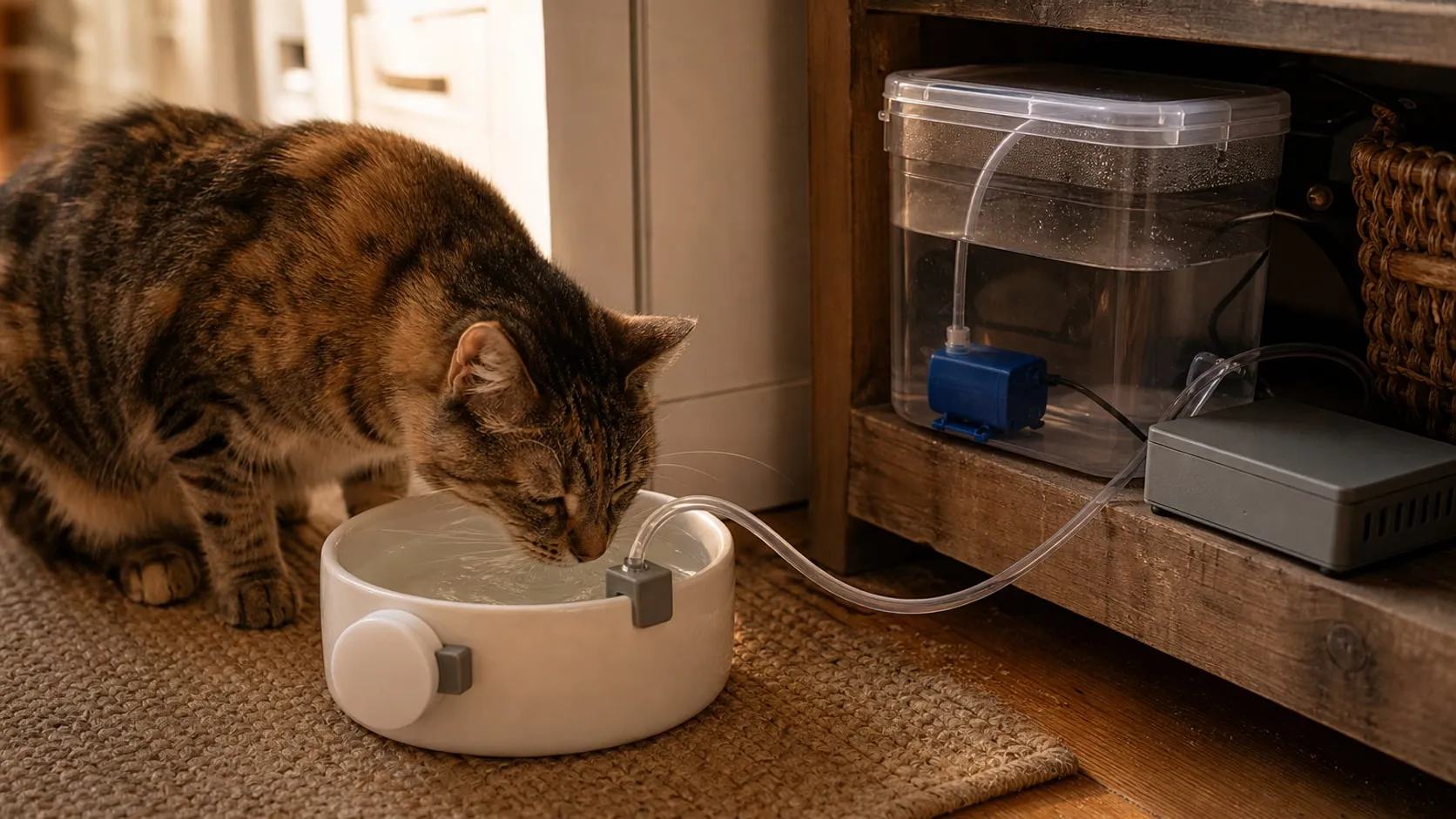
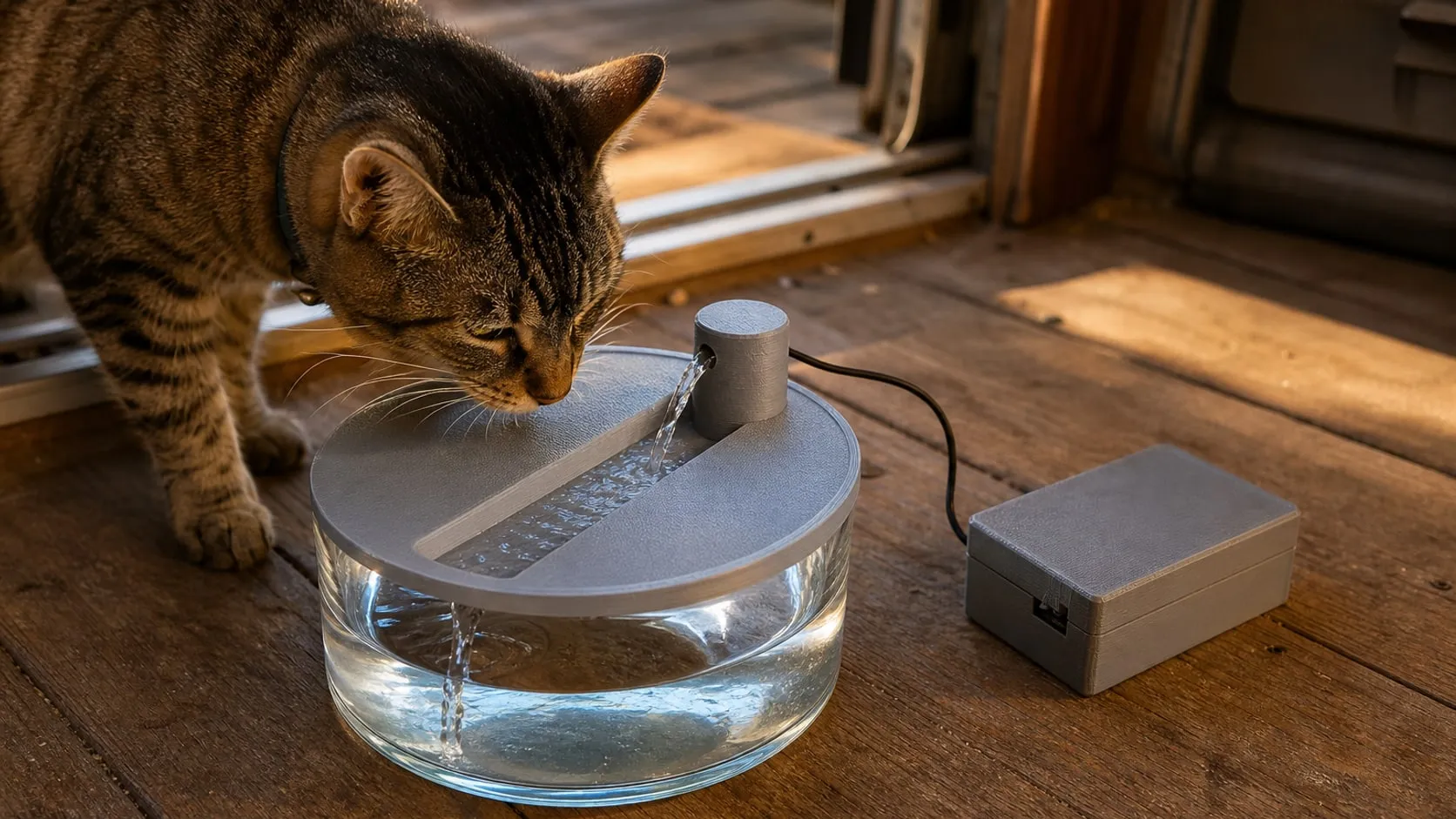
The fountain has four parts, and the rule is simple: only the bowl and the pump touch the water.
- Reservoir: a 7-cup glass bowl. Glass goes in the dishwasher and doesn’t hold smells, and it doesn’t have the layer lines of a printed tank, where slime can grow.
- Printed top: sits on the rim and holds the filter slot, the spout and a notch for the pump cable.
- Pump: sits on the bottom of the bowl under the top, pushing water up a short tube to the spout.
- Power bank: outside the bowl in its own closed, dry box, connected by the pump’s USB cable.
Keep the water path short and simple. A low spout that lets water run back down a sloped ramp is quieter and easier on the pump than a tall jet.
Step 2: Print the top and the battery box
Print in PETG rather than PLA; it handles water splashes, washing and a warm patio better. Most filaments aren’t certified for food contact, which is why the design keeps printed parts above the water.
- The top: a disc that rests on the bowl’s rim with a lip that drops a few millimetres inside it, so it centers itself. Leave a wide opening at the front for drinking.
- A spout: a short tube on the top with an outside diameter that fits snugly into the silicone tube, ending in a shallow ramp that lets the water run back into the bowl.
- A filter slot in the path of the returning water (Step 4).
- A cable notch in the rim, with a rounded edge so the lid doesn’t pinch the cord.
- A battery box with a lid, sized to the power bank, with the cable exit at the bottom.
Printables and MakerWorld have fountain tops and battery cases you can adapt to your bowl. Test-print just the rim ring first; it takes a few minutes and saves a failed full print if the fit is off.
Step 3: Fit the pump and riser
Measure the pump’s outlet and cut a piece of 6 mm silicone tube long enough to reach from it to the spout, with a little slack. Push one end onto the pump’s outlet and the other onto the printed spout. Soft silicone stretches over both and holds without a clamp, since a fountain pump runs at very low pressure.
Press the pump’s suction cups onto the clean, dry bottom of the bowl, under the spout, and run the cable up through the notch. Before you finish the top, fill the bowl and plug the pump into the power bank: check that water reaches the spout and that the flow is gentle. If the pump struggles, lower the spout.
Step 4: Add the easy-swap filter
The trick to an easy-swap filter is to design around one that already exists. PetSafe’s flat Drinkwell carbon filters are sold everywhere, so print a slot that matches them exactly.
- Measure a filter with calipers and add about 0.5 mm of clearance on each side, so a wet filter slides out without tearing.
- Put it where the water returns to the bowl: the water runs down the ramp, through the filter, then back into the bowl. Hair and food bits get caught before they reach the pump.
- Leave a finger grip on top of the slot, so you can pull the filter out without lifting the whole top.
- Rinse each new filter under the tap before it goes in, to wash out the loose carbon dust.
PetSafe says each filter lasts two to four weeks. In a small, busy fountain, change it when you see slime or the flow slows.
Step 5: Power it from the battery
Put the power bank in its printed box, close the lid and set the box next to the bowl or on a small shelf just above it. Plug the pump’s USB cable into one of the USB-A ports.
- Drip loop. Let the cable dip below the box before it rises into it. Water running along the cord then drips off at the low point instead of reaching the plug.
- Check the auto shut-off. Many power banks turn off when the load is very small. Run the pump for an hour and make sure the bank is still on. If it switches off, try another port.
- Time your runtime. Charge the bank fully, run the pump for 12 hours and note the percentage. The pump’s label reads 1.5 W, so a 20,000 mAh pack should last well over a day, but your spout height and the bank’s losses change that. Your own test is the number to trust.
- Swap, don’t top up. A second charged power bank lets you swap packs in seconds. Charge batteries indoors, away from the water, and don’t charge a bank that’s damp.
Step 6: Add feet and test it
Stick six or more silicone bumper pads around the outer edge of the bowl’s base and under the battery box. They stop the fountain sliding when a pet pushes on it, and keep the base off a wet floor. Clean the glass with alcohol first, so the adhesive holds.
Then run the full fountain on a towel for a day while you’re home:
- Look for drips around the cable notch, the spout and the battery box.
- Let the water run low on purpose. The pump should stay under water; if it starts to suck air, it needs a lower position or a bigger bowl.
- Watch your pet use it. Some pets are wary of a new sound or the pump’s light. Leave a plain bowl of water nearby until they’ve taken to it.
Step 7: Keep it clean on the road
A small fountain needs more care than a plain bowl, and it pays back with fresher water.
- Every day: top up the water and check the battery percentage.
- Every week: wash the bowl and the top, open the pump and clean the impeller, and rinse the riser.
- Every few weeks: replace the filter and, when it looks cloudy, the riser tube.
- Outdoors: keep the fountain in the shade (sun and clear water grow algae fast), and bring it inside when it freezes: a pump in ice can crack, and it won’t move water anyway.
A fountain doesn’t replace someone checking on your pet. On a long day out, leave a plain bowl of water next to it, so there’s still water if the battery runs out.
What it costs in time: a few hours of printing, half an hour to fit the pump and filter, and a day of testing at home. The parts for each step are below.
At a glance
6 picksAs an Amazon Associate I earn from qualifying purchases. If you buy through a link on this page we may earn a small commission, at no extra cost to you. How this works.
Pyrex Simply Store 7-Cup Round Glass Container
A dishwasher-safe glass bowl, so the part that holds the water isn't printed.
Printed plastic has layer lines where bacteria can grow, and most filaments aren’t certified for food contact. The simple fix is to print only the parts that sit above the water: the lid, spout and filter holder. The water itself sits in a plain glass bowl that goes in the dishwasher every week.
This Pyrex bowl is a good size for one or two cats: wide enough for a pump and a filter slot, low enough for a cat to drink comfortably, and heavy enough to stay where you put it.
Pro tip Design the printed top to rest on the bowl’s rim with a lip that drops a few millimetres inside it. The top then centers itself and can’t slide off when a pet bumps it.
Why we like it
- ✓7 cups (about 1.65 l / 56 oz) of water, plenty for a cat for a day or more
- ✓Glass doesn't absorb odors or stains, and it's top-rack dishwasher safe
- ✓Heavy, wide base that's hard for a pet to tip
- ✓Comes with a BPA-free lid for carrying the water on a trip
Keep in mind
- !Glass can break if dropped on a hard floor or patio
- !Heavier to pack than a plastic tub
- Capacity
- 7 cups (1.65 l)
- Material
- Glass bowl, BPA-free plastic lid
- Shape
- Round
- Care
- Top-rack dishwasher, microwave and freezer safe
Wonder Creature USB Cat Fountain Replacement Pump
A small 5 V fountain pump with a USB plug that runs straight off a power bank.
Most small USB pumps are sold for aquariums, but this one is made as a spare part for pet fountains: low voltage, a compact body that fits under a filter and suction cups that keep it from walking around the bottom of the bowl. For a battery-powered build, the USB plug is the real feature. It goes straight into a power bank, so no part of the fountain carries more than 5 V.
Small fountain pumps usually fail from hair and slime in the impeller, not from wear. Wonder Creature suggests cleaning it at least every two weeks, which fits the same routine as changing the filter.
Pro tip Before you design the lid, put the pump in a bowl of water with a piece of tubing on the outlet and raise the tube until the flow turns into a dribble. Make your spout a few centimetres lower than that.
Why we like it
- ✓Runs on 5 V USB, so a power bank powers it with no converter or wiring
- ✓Small (about 1.8 × 1.5 × 1.1 in) with suction-cup feet to hold it in place
- ✓IP68 rated and quiet, under 40 dB, Wonder Creature says
- ✓Opens up for cleaning, the step that keeps small pumps running
- ✓6 ft cord with a small LED on the line
Keep in mind
- !Flow rate isn't given on the listing, so test the height of your spout before you print the final lid
- !The LED on the cord is always on; cover it if your pet sleeps near the fountain
- Power
- 5 V USB (label reads 1.5 W)
- Size
- 1.8 × 1.5 × 1.1 in (4.6 × 3.8 × 2.8 cm)
- Cord
- 6 ft (1.8 m), USB-A
- Rating
- IP68
- Model
- W1501BL-C04
Quickun Food Grade Silicone Tubing (6 mm ID × 8 mm OD, 3.28 ft)
Food-grade silicone tube from the pump outlet up to the spout.
In a compact fountain, the tube is only a few centimetres long: from the pump’s outlet up through the printed lid to the spout. It’s still the one part the water runs through, so food-grade silicone is the right material.
Soft silicone also does the job of a hose clamp here. A fountain pump works at very low pressure, and a tube that stretches slightly over the outlet and a printed spout stays put without any clamp.
Pro tip Cut two risers at once and keep the spare in a bag with the filters. When the inside of the tube turns cloudy, swap it instead of trying to scrub it.
Why we like it
- ✓6 mm ID × 8 mm OD, a common size for small fountain pump outlets
- ✓Silicone compound compliant with FDA and 3-A sanitary standards, Quickun says; BPA free
- ✓Clear, so you can see slime building up inside
- ✓Soft (50A) and stretches over a slightly larger spout for a tight fit
- ✓3.28 ft (1 m) — enough for several replacement risers
Keep in mind
- !Measure your pump's outlet first; a much larger spout won't take a 6 mm tube
- !Soft enough to kink on a tight bend
- Size
- 6 mm ID × 8 mm OD (1 mm wall)
- Length
- 3.28 ft (1 m)
- Material
- Silicone, food grade
- Hardness
- 50A
charmast 20,000 mAh Power Bank with Built-in Cables
A flat 20,000 mAh pack with a percentage display for runtime checks.
A pet fountain pump is a tiny, steady load, and that’s what a large power bank handles well. Rated cell capacity isn’t what you get at 5 V, but even after conversion losses a 20,000 mAh pack holds many times what a 1.5 W pump uses in a day. The flat shape matters too: it slides into a drawer under the reservoir instead of sitting next to it.
The percentage display is the useful part for a fountain. You can see at a glance how much the pump used overnight and plan when to swap in a charged pack.
Pro tip Charge it, run the pump, and note the percentage after 12 hours. That one test tells you how many days a charge lasts with your pump and your spout height, better than any calculation.
Why we like it
- ✓20,000 mAh in a flat 6.3 × 2.85 × 0.75 in pack that fits under a fountain
- ✓Digital display shows the exact charge from 0 to 100%
- ✓Six outputs, including USB-A ports for a USB pump
- ✓Built-in cables, so nothing extra to lose on a trip
- ✓36-month warranty, charmast says
Keep in mind
- !Has auto shut-off; most power banks cut out at very low draw, so check that it stays on with your pump
- !Not water resistant — it has to live in a dry, closed compartment
- !A full recharge takes about 6 hours
- Capacity
- 20,000 mAh
- Max output
- 22.5 W
- Outputs
- 6 (USB-A, USB-C, built-in cables)
- Cell type
- Lithium polymer
- Size
- 6.3 × 2.85 × 0.75 in (16 × 7.2 × 1.9 cm)
- Model
- C2065
QUEENTI Clear Silicone Bumper Pads (160 Pack)
Clear silicone dots that stop the fountain sliding when a pet drinks.
A fountain sits on the floor, and pets push it: they lean in to drink, bat at the water and nose the spout. A ring of silicone feet on the bottom stops it from sliding around, and lifts it a few millimetres off a wet floor so the base can dry.
They’re small enough to also go under the battery drawer and the electronics box, anywhere hard plastic would otherwise rattle or scratch.
Pro tip Place the feet near the outer edge of the base, six or more for a round fountain. Feet near the middle let it rock when a pet pushes on the rim.
Why we like it
- ✓Small 0.5 in dots, 0.14 in tall — nearly invisible under a base
- ✓Silicone, waterproof and non-slip, QUEENTI says
- ✓Self-adhesive, no glue to mix
- ✓160 in a pack, enough for every project on the bench
Keep in mind
- !Adhesive needs a clean, dry, smooth surface; on rough printed plastic, sand or wipe it with alcohol first
- !Small dots grip less on wet tiles; use more of them, spread out to the edges
- Size
- 0.5 in diameter × 0.14 in tall (12.7 × 3.6 mm)
- Material
- Silicone
- Count
- 160 pads