Winter Paw Care Checklist
A tick-list for winter paws — trim the fur and nails, salt-free melt at home, boots or a rinse after salted walks, balm at night.
Published October 12, 2026 · 6 picks
At a glance
6 picksAs an Amazon Associate I earn from qualifying purchases. If you buy through a link on this page we may earn a small commission, at no extra cost to you. How this works.
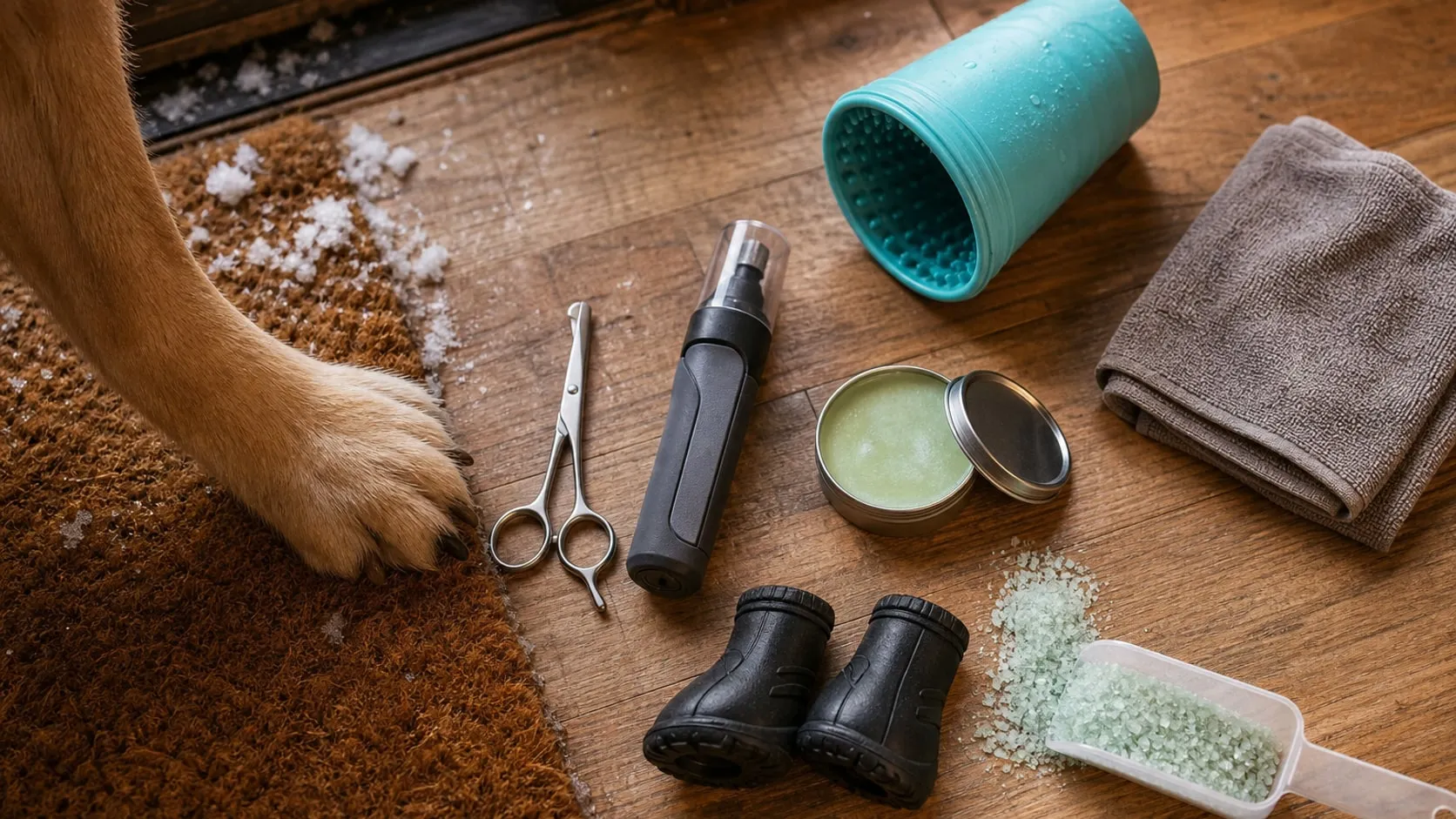
Tweezerman Pet Grooming Scissors, Rounded Tip
Rounded tips for trimming the fur between the pads, where ice balls start.
Ice balls start with fur. Long tufts between the pads pick up snow, the snow melts from body heat and refreezes into hard little lumps that spread the toes and pull on the skin. Trimming that fur level with the pads before winter is the single best thing you can do against them, and it also gives paw wax or balm bare skin to work on.
Rounded tips are the point here. You’re cutting right next to the pads and the webbing between the toes, and a pointed blade there is one twitch away from a cut.
Pro tip Spread the toes with your thumb and cut the fur level with the pads, not into the gaps. You want it flat, not scooped out; the hair between the toes still protects the skin underneath.
Why we like it
- ✓Rounded tips are made to avoid nicking skin near pads, eyes and ears
- ✓Curved blade follows the shape of the paw
- ✓Stainless steel, light in the hand
- ✓Ambidextrous finger loops with a finger rest
Keep in mind
- !Small blades; not for trimming the whole coat
- !Rounded tips still cut; a wriggling dog needs a second person to hold the paw
- !Needs cleaning with alcohol after each use, per the maker
- Blade
- Stainless steel, curved
- Tips
- Rounded safety tips
- Hand
- Ambidextrous
- Weight
- 0.04 kg (1.4 oz)
- Model
- 7102-PGC
Dremel PawControl 7760-PET Nail Grinder Kit
Takes winter-long nails back a little at a time, with a guard that sets the angle.
Winter is when nails get long without anyone noticing. Walks get shorter and happen on snow instead of pavement, so nails stop wearing down, and a long nail on ice pushes the toes apart and costs the dog grip. A grinder takes them back a little at a time, and it’s easier to see where to stop than with a clipper, especially on dark nails.
The guard is the part that makes this one easy for beginners: the nail goes through the opening at the right angle, and the dust stays mostly inside it. Start on the lowest speed for a second or two per nail and work up.
Pro tip Touch the grinder to each nail for a second, then move on and come back. Holding it on one nail heats it up, and a dog remembers that.
Why we like it
- ✓Paw guard holds the nail at a 45° angle and catches the dust
- ✓Four speed settings from 8,000 to 25,000 rpm
- ✓Cordless 4 V lithium-ion battery that charges by USB
- ✓Nine sanding accessories in the kit, changed with Dremel's EZ Twist nose cap
- ✓Two-year warranty, per the kit
Keep in mind
- !Slower than a clipper on long nails; plan several short sessions
- !The noise and vibration take a few days of getting used to for most dogs
- !Long fur can catch in the spinning band; hold the hair back or use the guard
- Power
- 4 V lithium-ion, USB charging
- Speed
- 8,000–25,000 rpm, 4 settings
- Guard
- 45° paw guide with dust collection
- Accessories
- 9 sanding bits and bands
- Weight
- 9.6 oz
- Model
- 7760-PET
Safe Paw Salt-Free Ice Melt, 35 lb Pail
Salt-free ice melt for your own steps and path, so that stretch is salt-free.
Rock salt is everywhere in winter, and it’s hard on paws: the crystals sit between the pads, dry the skin and sting in any crack, and the dog licks the rest off at home. On the part of the walk you control, from the door to the sidewalk, you can skip it entirely. Safe Paw uses calcium magnesium acetate instead of sodium or calcium chloride, and the grit in each granule gives some grip before the ice has melted.
It won’t make the whole neighborhood safe, and it doesn’t need to. Clear the steps and path, use a light, even scatter rather than a thick layer, and let the rest of the checklist handle the salted sidewalks beyond your gate.
Pro tip Shovel first, then spread. Ice melt works on the thin layer left on the pavement, not on inches of snow, and you’ll use far less of it.
Why we like it
- ✓Salt- and chloride-free, made with calcium magnesium acetate and an amide core
- ✓Grit mixed into the granules adds grip on icy steps right away
- ✓Safe Paw says it's non-corrosive to concrete, pavers, asphalt and wood
- ✓About 100 sq ft per pound, per the maker, so one pail covers a lot of path
- ✓Resealable pail with a handle that keeps the granules dry between storms
Keep in mind
- !Only fixes your own property; sidewalks and streets are still salted, so paws need rinsing anyway
- !The grit tracks indoors on boots and paws
- !A 35 lb pail is heavy to carry and takes floor space in the garage
- Size
- 35 lb pail
- Active ingredients
- Calcium magnesium acetate, crystalline amide core, traction grit
- Salt/chloride
- None, per the maker
- Melting point
- Down to -2°F (-19°C), per the maker
- Coverage
- About 100 sq ft per lb, per the maker
- Pail
- 15 × 12.5 × 12.5 in, with lid and handle
- Model
- ZW152 35
PawZ Rubber Dog Boots, Medium (12-Pack)
Thin pull-on rubber boots for salted sidewalks, for dogs that won't wear bulky ones.
Plenty of dogs walk like they’re on hot coals in thick boots with soles and straps. Thin rubber boots are the other approach: closer to a balloon than a shoe, they keep salt and slush off the pads while the dog still feels the ground. For a dog that refused proper boots, they’re often the version that stays on.
The trade-off is durability. They’re meant to be replaced one boot at a time, which is why there are twelve in a pack; expect to lose a few to sharp ice and gravel over a season.
Pro tip Measure the paw width while the dog stands on it, and if it’s between sizes, go up, since the maker says they run small. Spread the opening with both hands and roll it up the paw like a sock, toes first.
Why we like it
- ✓Thin rubber, so the dog still feels the ground and walks more naturally
- ✓Waterproof; salt water and slush stay outside
- ✓Pull-on with no straps or buckles
- ✓Twelve boots per pack, so a torn one is just replaced
Keep in mind
- !Thin rubber can tear on ice crust, gravel or a dewclaw; the maker sells them as disposable
- !Fiddly to pull on the first few times, and they run small, per the maker
- !No insulation; they keep paws dry, not warm
- !Natural rubber, so not for dogs with a latex allergy
- Size on this listing
- Medium, for paws 2.5–3 in wide
- Pieces
- 12 boots
- Material
- Natural rubber
- Closure
- Pull-on
- Care
- Hand wash
- Model
- 975114
Dexas MudBuster Paw Cleaner, Large
A cup of lukewarm water and soft bristles that rinse the salt out at the door.
The single most useful winter paw habit is also the most boring one: rinse the salt off before it dries on the pads or gets licked off. A cup with bristles turns that into a twenty-second job at the door instead of a trip to the bathtub, and lukewarm water melts the ice balls stuck in the fur at the same time.
Pick the size by the width of the paw, not the weight of the dog. Measure a front paw while the dog stands on it; if it’s close to the top of a range, go up a size so the paw fits without being squeezed.
Pro tip Use lukewarm water, not hot. Paws coming in from the cold feel hot water much more than you do, and a dog who gets one unpleasant dip will fight the cup from then on.
Why we like it
- ✓Soft 1 in silicone bristles reach between the pads where salt collects
- ✓Add water, dip, twist, dry; no sink or bathtub needed
- ✓Sized by paw width, three sizes on the same listing
- ✓Light enough to keep by the door or in the car
Keep in mind
- !One paw at a time, so four dips per walk
- !You still need a towel; the paw comes out wet
- !The water gets dirty fast and needs changing every walk or two
- Size on this listing
- Large, for paws 2.5–3.5 in wide
- Other sizes
- Small (up to 2 in), Medium (1.5–2.5 in)
- Bristles
- 1 in, BPA-free silicone
- Dimensions
- 4.75 × 4.75 × 8.85 in
- Weight
- 8.6 oz
- Model
- PW720312
Bag Balm Pet Paw & Skin Balm, 8 oz (2-Pack)
A heavy salve worked into dry pads at night, after the last walk.
Winter dries pads from both sides: salt and cold outside, dry heated air inside. Once the skin starts to crack, a protective wax before walks isn’t enough. The pad needs moisture back, and that’s what a heavy salve like Bag Balm is for. Lanolin softens tough skin, petrolatum seals it in.
The best time is the evening, after the last walk and after the paws are rinsed and dried. A thin layer worked into the pads, a few minutes of distraction while it soaks in, and the cracks have all night to settle down.
Pro tip Cracks that bleed, smell or make the dog limp are for the vet, not for balm. Balm is for dry and rough, not for open and sore.
Why we like it
- ✓Short ingredient list built on lanolin and petrolatum
- ✓No added fragrance, colors, alcohol, parabens or phthalates
- ✓Two 8 oz tins, enough for one by the door and one in the car
- ✓Works on noses and dry elbow patches as well as pads
Keep in mind
- !Greasy; leaves marks on floors and bedding unless rubbed in well
- !It's a moisturizer, not a walking wax; apply after walks, not before
- !Dogs tend to lick it off, so use a thin layer and distract for a few minutes
- Size
- 2 × 8 oz tins (16 oz total)
- Key ingredients
- Petrolatum, lanolin
- Free of
- Added fragrance, colors, alcohol, parabens, phthalates
- Tin
- 3 × 6 × 2.4 in
- Made in
- USA (Vermont)
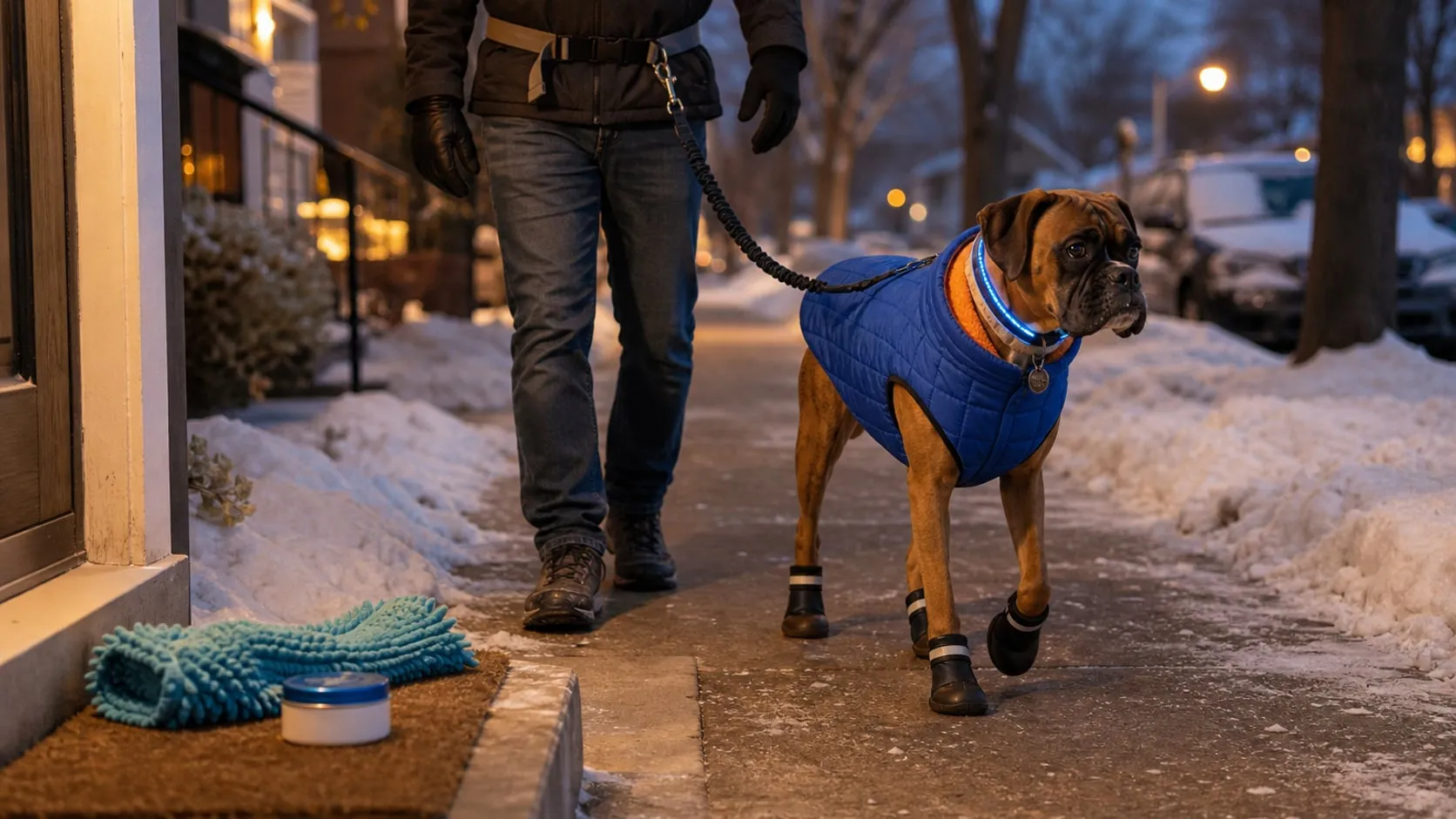
Winter paw trouble comes from four places: salt and de-icer on the sidewalks, snow that freezes into balls between the toes, nails that grow long when walks get short, and pads that dry out and crack. Save this list and tick it off through the season. Each line is one action, and the gear for it is below.
Before the first snow
- Trim the fur between the pads level with the pads, with rounded-tip scissors.
- Shorten the nails. Long nails on ice spread the toes and cost grip.
- Swap rock salt for a salt-free melt on your own steps, path and driveway.
- Measure paw width and try boots indoors for a few short sessions with treats.
Every walk
- Boots on for salted sidewalks, or check that the dog will walk normally without them.
- Check between the toes halfway on long walks; break off ice balls by hand, never pull them.
- Turn back if the dog lifts its paws, limps or refuses to walk.
At the door
- Rinse all four paws in lukewarm water, even after boots.
- Dry between the toes with a towel, so nothing refreezes or stays damp.
Every evening
- Look at the pads for redness, cracks or licking between the toes.
- A thin layer of balm on dry pads, then a few minutes of distraction.
Every two weeks
- Re-trim the paw fur and grind the nails a little.
- Inspect the boots for tears and replace any that leak.
Bleeding cracks, swelling, a smell or a limp that doesn’t go away after a day are for the vet, not for balm.