Keep an Older Dog Warm at Night: The Setup
Find the cold spot, stop the floor draft, lift the bed off the floor and add a warm spot the dog can leave — a night setup for senior and short-coated dogs.
Published October 12, 2026 · 6 picks
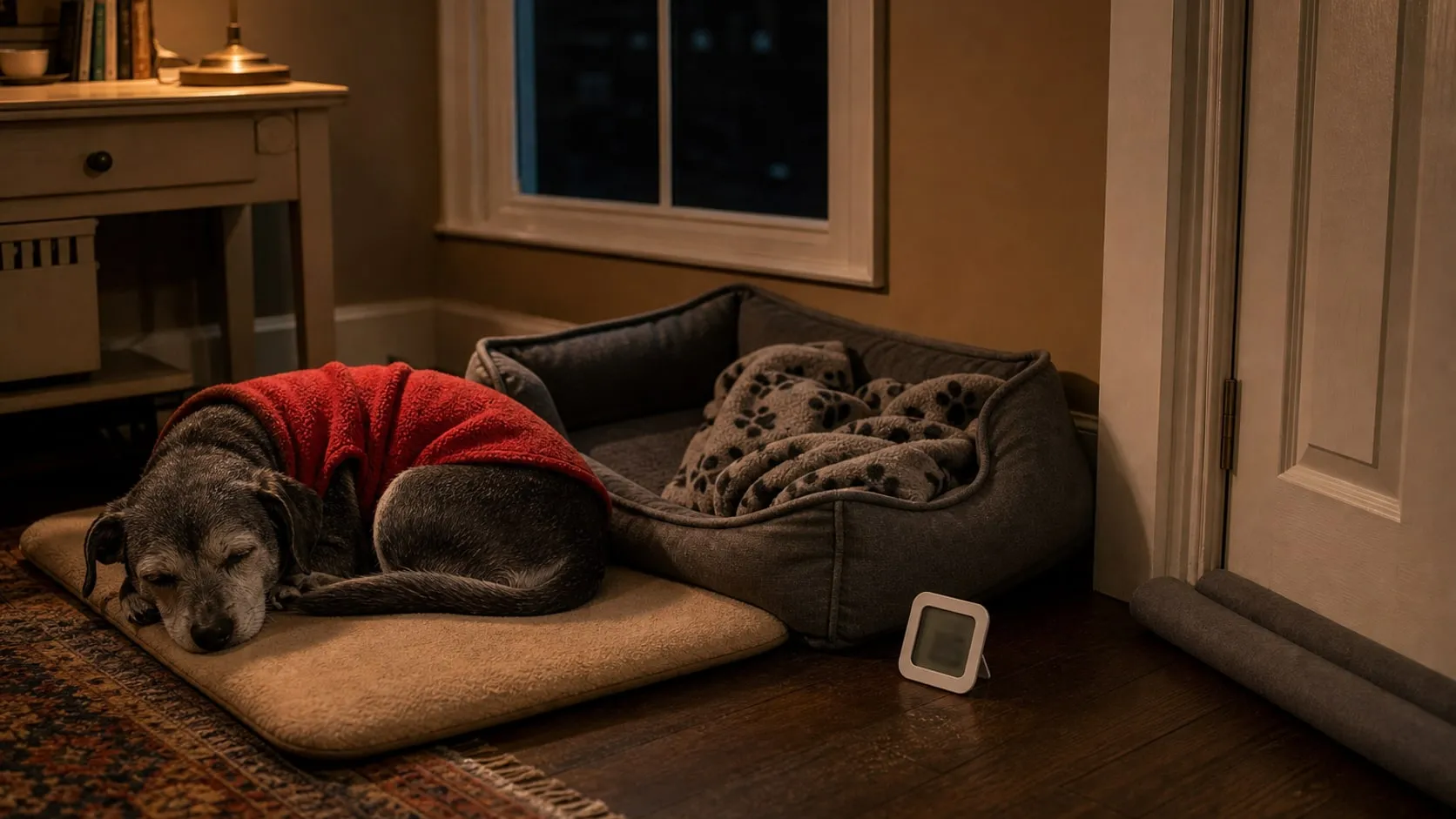
The first frost always shows up in the same places: the old dog who used to sprawl now sleeps curled tight, gets up stiff, or wanders at 3 a.m. looking for a warmer spot. Senior dogs carry less muscle and regulate heat less well, and short-coated breeds like greyhounds, whippets, Chihuahuas and boxers never had much insulation to begin with. You don’t need to heat the whole house for them. You need to fix one corner of one room, at floor level, from the floor up. Here’s the setup, step by step, with the gear for each step below.
Step 1: Find out how cold the dog’s corner really gets
The thermostat on the wall measures the air at chest height in the middle of the house. The dog sleeps on the floor, often by a door or an outside wall, and on a cold night that spot can sit several degrees lower.
- Put a thermometer on the floor right next to where the dog sleeps, away from any heater.
- Clear the high/low record at bedtime. In the morning the low is the coldest moment of the night, at the dog’s level.
- Try a second spot the next night, an inside wall or another room the dog is happy in. The warmer corner is where the bed goes.
There’s no single safe number for every dog: a thin-coated senior Chihuahua feels a chilly room long before a husky does. Use the reading to compare spots and to see whether the steps below change anything, and watch the dog as much as the display.
Step 2: Stop the draft along the floor
Cold air sinks, and the gap under a door feeds a steady stream of it along the floor, right through a dog bed. Block it before you add any heat.
- Slide a draft stopper under the door nearest the bed: the sleeve goes under the door with a foam tube on each side, so it moves with the door. Check the fit first; this one is for doors 1 to 1.7 in thick and low thresholds.
- Move the bed off the draft line. Not in front of the door, not under a window, and not against an outside wall if an inside one is available.
- Test it. On a windy evening, hold a strip of tissue at the gap under the door before and after. If it still flutters, the draft is coming from somewhere else, like the door frame or a floor vent.
Step 3: Get the bed off the floor
A dog lying on tile or a thin mat loses heat into the floor all night, and stiff joints feel every hard inch. A few inches of foam fixes both.
- Pick orthopedic foam and bolsters. The bolsters on three sides give the dog a headrest and a low wall against whatever draft is left.
- Choose the size by weight and sleeping style. A dog that curls up fits the size for their weight; one that stretches out needs the next size up.
- Turn the open side to the room and the back bolster to the inside wall. The front should be low enough that a dog with sore hips walks in instead of jumping.
Step 4: Add a warm spot the dog can leave
Heat is the part that makes the biggest difference and the part to get right. The rule that matters most, and the one vets repeat: the dog must always be able to move off the heat on their own.
- Use a pad made for pets, not a human heating pad. The one in the picks has its own thermostat, warms toward a pet’s body temperature only when there’s weight on it, and draws 40 watts.
- Place it as a second bed, next to the unheated one, not inside it, so the dog chooses warm or cool through the night. In a crate, the pad covers half the floor at most.
- Run the steel-wrapped cord along the wall straight to an outlet, not across the walkway and not through a power strip lying behind the bed.
- Check it the right way. An empty pad feels barely warm to the hand by design. Follow the test the maker shows, then trust the dog: lying on it is a yes, getting up and moving off it is information, not a fault.
Talk to your vet first if your dog can’t get up easily on their own, has lost sensation in their legs, is recovering from surgery, or doesn’t respond normally to heat. For a dog that can’t move off a warm surface, heat is a risk, not a comfort. Unplug the pad if the dog chews the cord or the cover.
Step 5: Give them something to nest in
Many dogs, seniors especially, circle and dig before they settle. A loose fleece throw on the unheated bed gives them something to build a nest with, and the folds keep a little warmth around them.
- Drape it over the unheated bed, bunched at one end, not folded thick on top of the heated pad. A heavy layer over a pad traps more heat than its thermostat is made for.
- Keep two and swap them on wash day. A blanket that smells like the dog’s own bed helps them settle.
Step 6: Add a layer for thin coats
For short-coated breeds and very lean seniors, a light fleece vest adds insulation exactly where they lose it, over the back and chest. Long and double-coated dogs usually don’t need one indoors.
- Measure back length, base of the neck to base of the tail, and check the chest size against the chart.
- Pick stretch and no straps. Buckles and seams press on a dog that’s lying down all night.
- Try it for an evening first. If the dog lies, stretches and gets up without fussing at it, it can stay on for the night. Check under the front legs for rubbing in the morning, and take it off if the dog pants or goes looking for the cool floor.
Step 7: Watch the first nights
The setup is right when the dog sleeps through and gets up without the old stiffness, and you can tell that in a few days.
- Check the morning low on the thermometer for a few nights. If the corner is still much colder than the rest of the room, look for another draft or move the bed.
- Watch where the dog ends up. On the heated pad all night, on the unheated bed, or switching between them are all fine. Leaving both for the bare floor means it’s too warm, or the spot is wrong.
- Watch for warning signs. Shivering, tight curling and reluctance to get up mean the dog is still cold. Panting, restlessness or red skin where the dog lies on the pad mean too much heat; remove the pad and call your vet if it doesn’t settle.
- Inspect weekly. Unplug the pad, check the cord for bite marks and the cover for wear, and wash the blanket. A damaged pad gets replaced, not taped.
What it costs in time: one night of measuring, half an hour to fit the draft stopper and set up the beds, and a week of watching. The gear for each step is below.
At a glance
6 picksAs an Amazon Associate I earn from qualifying purchases. If you buy through a link on this page we may earn a small commission, at no extra cost to you. How this works.
TempPro TP50 Indoor Thermometer & Hygrometer
Sits on the floor by the bed overnight and keeps the night's low on screen for the morning.
The thermostat on the wall reads the air at chest height in the middle of the house. The dog sleeps on the floor, often in the coldest corner, and on a frosty night that spot can be several degrees colder than the number on the wall. A small thermometer set on the floor next to the bed for one night tells you whether there’s a problem at all.
The useful part is the low record. Clear it at bedtime, and the morning reading shows the coldest moment of the night at the dog’s level. Move it to another corner the next night and you know which spot is the warmer one before you move the bed.
Pro tip Set it on the floor next to the bed, not on a shelf above it, and away from the heated pad so it reads the room, not the heat. Reset the high/low at bedtime so the morning low belongs to that night.
Why we like it
- ✓Keeps the high and low temperature and humidity on screen, so last night's minimum is waiting in the morning
- ✓Rated ±1°F, updates every 10 seconds
- ✓Big digits; humidity icon shows dry, comfort or wet at a glance
- ✓Stands on its own or sticks to metal with the magnetic back
- ✓Runs on a single AAA battery, included
Keep in mind
- !Indoor only, no remote sensor; it measures where it stands
- !No alarm, app or history beyond the high and low
- !No backlight, so reading it at night means a light
- !The high/low record has to be cleared by hand to start a fresh night
- Accuracy
- ±1°F temperature, ±2–3% RH
- Updates
- Every 10 seconds
- Records
- High and low, temperature and humidity
- Units
- °F / °C switch
- Mounting
- Tabletop stand or magnetic back
- Power
- 1 × AAA (included)
- Model
- TP50 (TempAir CORE)
Holikme Under Door Draft Stopper, 36 in
Two foam tubes under the door stop the cold stream that runs along the floor.
The coldest air in a room is the stream that runs along the floor from the gap under the door, and that’s exactly the height a dog sleeps at. A draft stopper is the cheapest fix in this setup and often the one that makes the biggest difference to the bed in the corner.
This one is two foam tubes joined by a fabric sleeve: the sleeve slides under the door, a tube sits on each side, and the whole thing travels with the door as it opens. Nothing is screwed or glued, so it comes off in spring without a trace.
Pro tip Measure before you buy: door thickness has to be 1 to 1.7 in, and the gap at the threshold small. Then light a candle or hold a strip of tissue at the gap on a windy evening, before and after, to see the draft stop.
Why we like it
- ✓Slides under the door with a tube on each side, so it moves with the door instead of being kicked aside
- ✓No screws or adhesive, which suits rentals
- ✓Foam tubes sit in a sleeve closed with hook and loop, so they stay put through daily opening and closing
- ✓Comes in several lengths and colors on the same listing
Keep in mind
- !Fits doors 1 to 1.7 in thick only, and not over thresholds taller than about 0.3 in
- !Adds drag to a door that already sits close to the floor or carpet
- !A dog that chews soft things will find two foam tubes at nose height
- !Blocks the gap under the door only; drafts from windows and frames need their own fix
- Length
- 36 in (91 cm)
- Door thickness
- 1–1.7 in (2.5–4.3 cm)
- Threshold
- Up to about 0.3 in (8 mm)
- Build
- Two foam tubes in a polyester sleeve, hook-and-loop closure
- Mounting
- Slides under the door, no tools
- Color
- Gray (this link)
Furhaven Orthopedic Sofa Dog Bed, Plush & Suede, Medium
Orthopedic foam off the cold floor, with bolsters on three sides against the draft.
An old dog that sleeps on the floor loses heat into it all night, and stiff joints feel every hard inch. Lifting the dog a few inches onto foam fixes both at once. This sofa-style bed puts egg-crate orthopedic foam under the whole sleep surface and wraps three sides in bolsters, which give a tired head somewhere to rest and stop the cold air that creeps along the floor from reaching the dog’s back.
The open fourth side is low, so a dog with sore hips steps in rather than jumping. Sizing goes by weight: Medium is for dogs up to 35 lb, and the same listing goes from small dogs to giant breeds. For a dog that sleeps stretched out, size up one step.
Pro tip Put the open side facing the room and the back bolster against the inside wall, not the outside one or a window. The bolsters then block the draft from the door instead of trapping the cold from the glass.
Why we like it
- ✓Convoluted egg-crate orthopedic foam under the whole sleep surface, aimed at older and arthritic dogs
- ✓Bolsters on three sides work as a headrest and a wall against floor-level drafts
- ✓Low open front, so a stiff dog walks in instead of climbing
- ✓Cover comes off with two zippers and is machine washable
- ✓Five sizes on the same listing, from dogs up to 20 lb to dogs up to 125 lb
Keep in mind
- !Egg-crate foam is softer and thinner than a solid memory-foam slab; a heavy dog at the top of the size range will feel the floor sooner
- !The faux fur holds hair and needs the cover off for a proper clean
- !Bolsters are fiber-filled and flatten over time with a dog that leans on them every night
- !Not waterproof; an incontinent senior needs a liner or a washable blanket on top
- Size
- 30 × 20 × 6 in (76 × 51 × 15 cm), Medium
- Dog weight
- Up to 35 lb (16 kg)
- Foam
- Egg-crate orthopedic foam
- Cover
- Faux fur sleep surface, suede-style bolsters
- Care
- Removable cover, machine washable
- Model
- 45336087BX
K&H Lectro-Soft Heated Pet Bed, Medium 24 × 19 in
A 40 W heated pad that warms toward body temperature only while the dog lies on it.
A heated spot is the strongest part of this setup, and also the one to get right. This pad is made for exactly that job: it has its own thermostat and, K&H says, only warms up to a pet’s normal body temperature while there’s a pet on it. With nobody on it, it gives off just a little heat. At 40 watts it can stay plugged in all winter without the worry a space heater by the dog bed brings.
It’s sold as an outdoor bed for sheds and garages, which is why it’s built around a wipeable vinyl pad, a steel-wrapped cord and a fleece cover that comes off for the wash. Indoors that makes it a sturdy second bed: the warm option next to an unheated one, so the dog can choose.
Pro tip A quick touch of the empty pad tells you nothing. To check it works, follow the “How to Test” picture on the listing: the pad has to feel weight and trapped heat for a while before it warms up, the way it does under a dog.
Why we like it
- ✓Thermostatically controlled; K&H says it warms the surface to a pet's normal body temperature only when the pet is on it
- ✓Draws 40 watts, a fraction of a space heater
- ✓Orthopedic foam base inside the pad, plus a washable fleece cover in the box
- ✓Steel-wrapped cord, about 5½ ft long
- ✓Safety listed; K&H certifies the whole product, not just its parts
Keep in mind
- !Feels barely warm to your hand when nobody is on it, which looks like a fault until you test it the way K&H shows
- !No temperature setting and no switch; it's on whenever it's plugged in
- !Not recommended for dogs that chew, despite the steel cord
- !The vinyl pad is firm and only 1.5 in thick; it's a warm layer, not a mattress for a heavy dog
- Size
- 24 × 19 × 1.5 in (61 × 48 × 4 cm), Medium
- Power
- 40 W
- Control
- Built-in thermostat, warms when the pet lies on it
- Cord
- About 5½ ft (1.7 m), steel-wrapped
- Cover
- Fleece, removable, machine washable
- Pad
- Vinyl (PVC) shell, foam inside
Gooby Stretch Fleece Vest Dog Sweater
A stretch fleece vest for thin coats, with no straps to press on a dog lying down.
Short-coated breeds and thin-coated seniors carry very little insulation of their own. A light fleece vest adds a layer right where it counts, over the back and chest, and the stretch fabric means there are no straps or buckles to dig in when the dog lies down.
Sizing goes by back length, from the base of the neck to the base of the tail, with a chest measurement as the second check. Gooby suggests a neck opening wider than the dog’s head, which matters on a garment that goes on over it.
Pro tip Try it for an evening before the first night. If the dog can lie, stretch and get up without fussing at it, and there’s no rubbing under the front legs in the morning, it’s a fit. Take it off if the dog pants or seeks the cool floor.
Why we like it
- ✓Stretch fleece follows the body without a strap or buckle to press on a dog that's lying down
- ✓Mock neck covers the base of the neck, where thin coats lose heat
- ✓Sized by back length, with a chart from 7 to 27.5 in on the same listing
- ✓Light, about 1.8 oz in Medium, so there's little weight on a dog that's lying down
Keep in mind
- !Pulls over the head; a dog with sore shoulders or a neck problem may not like it
- !Covers the chest and back only, not the belly or legs
- !One layer of fleece; for a dog that's truly cold, the bed and the room matter more
- !Any garment worn overnight needs a fit check for rubbing under the front legs
- Size
- Medium, back length 11.5 in (29 cm)
- Chest
- About 16 in (41 cm)
- Neck
- About 11.5 in (29 cm)
- Material
- Stretch polyester fleece
- Closure
- Pull-on, mock neck
- Care
- Hand wash recommended
- Color
- Red (this link)